
El manejo de los cultivos tradicionales como elemento de sostenibilidad en el conuco cubano
Article Sidebar
Main Article Content
Abstract
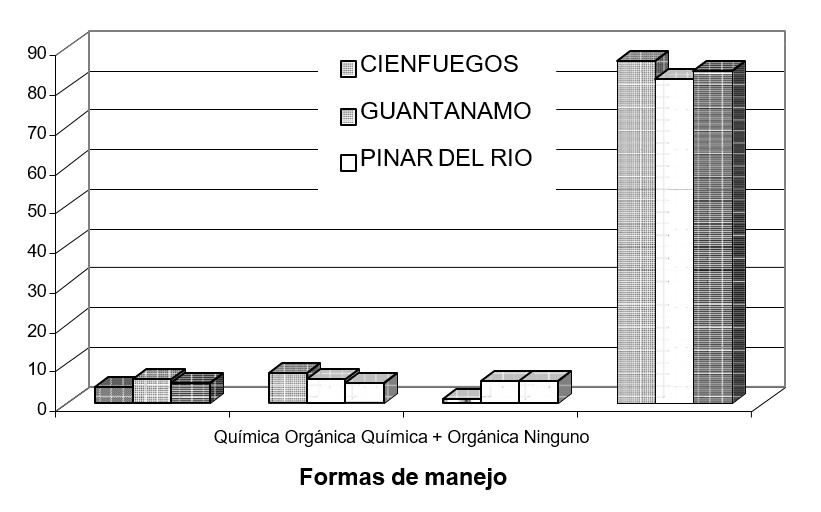
The management of home gardens in three Cuban regions was evaluated considering the using of the agricultural procedures, and the characteristics of seed production in each species within them. The management of the species within the gardens was weighted using a sample of them, representing three Cuban regions, located in the Western (13 home gardens), Central (12 home gardens) and Eastern (14 home gardens) parts of the country, and by means of semi-structured interviews mainly to the garden’s owners. The type of fertilizers, forms of soil preparation, non-managed species and water supply were evaluated. It was appreciated, in general, that in the three areas, the management of the species is done in a little agressive form to the environment, since harvesting is mostly by hand, as well as soil and weed control, where they use only in some cases animals. Most of the species are managed without irrigation, only with the benefits of rainfalls, and also they use most of the cases organic fertilizers, or they do not use them at all. So it can be assumed a sustainable management in agricultural procedures in the studied Cuban home gardens.
Article Details

This work is licensed under a Creative Commons Attribution-NonCommercial 4.0 International License.
Those authors who have publications with this journal accept the following terms of the License Attribution-NonCommercial 4.0 International (CC BY-NC 4.0):
You are free to:
- Share — copy and redistribute the material in any medium or format
- Adapt — remix, transform, and build upon the material
The licensor cannot revoke these freedoms as long as you follow the license terms.
Under the following terms:
- Attribution — You must give appropriate credit, provide a link to the license, and indicate if changes were made. You may do so in any reasonable manner, but not in any way that suggests the licensor endorses you or your use.
- NonCommercial — You may not use the material for commercial purposes.
- No additional restrictions — You may not apply legal terms or technological measures that legally restrict others from doing anything the license permits.
The journal is not responsible for the opinions and concepts expressed in the works, they are the sole responsibility of the authors. The Editor, with the assistance of the Editorial Committee, reserves the right to suggest or request advisable or necessary modifications. They are accepted to publish original scientific papers, research results of interest that have not been published or sent to another journal for the same purpose.
The mention of trademarks of equipment, instruments or specific materials is for identification purposes, and there is no promotional commitment in relation to them, neither by the authors nor by the publisher.
How to Cite
References
Abdoellah, O. S. (1990): Homgardens in Java and their future development. In: K. Landauer and M. Brazil (Ed.), Tropical Home Gardens. United Nations Univ. Press, Tokyo: 69-79.
Achuthan Nair, M. & C. Sreedharan (1986): Agroforestry farming systems in the homesteads of Kerala, Southern India. Agrofor. Syst., 4: 339-363.
Alvarez-Buylla Roces, M. E., Lazos Chavera, E. & García-Barrios, J.R. (1989): Homegardens of a humid tropical region in Southeast México: an example of an agroforestry cropping system in a recently established community. Agrofor. Syst., 8: 133-156.
Bompard, J. M. (1986): Arboriculture fruitiére in Indonésie occidentale: traditions et perspectives. Fruits, 41 (9): 531-551.
Castiñeiras, L., T. Shagarodsky, Z. Fundora, V. Fuentes, L. Fernández, V. Moreno, A.V. González, J. L. Alonso, R. Orellana, R. Robaina, R. Cristóbal, P. Sánchez, M. García, A. Valiente y C. Giraudy (1999): Contribución de los huertos caseros a la conservación in situ de recursos fitogenéticos en sistemas de agricultura tradicional. Informe Final, Proyecto Global IPGRI-INIFAT-GTZ, Año 1: 100 pp.
Castiñeiras, L., Z. Fundora Mayor, T. Shagarodsky, V. Moreno, L. Fernández y R. Cristóbal (2002): Contribution of home gardens to in situ conservation of plant genetic resources in farming systems- Cuban Component. En: Home gardens and in situ conservation of plant genetic resources in farming systems. Proceedings of the Second International Home Gardens Workshop, 17-19 julio, Witzenhausen, Rep. Federal Alemana. International Plant Genetic Resources Institute, Rome: 42-55.
Christanty, L. (1990): Homegardens in tropical Asia, with special reference to Indonesia. In: K. Landauer and M. Brazil (Ed.), Tropical Home Gardens. United Nations Univ. Press, Tokyo: 9-20.
Fernandes, E. C. M. & P. K. R. Nair (1986): An evaluation of the structure and function of tropical homegardens. Agric. Syst., 21: 279-310.
Fundora Mayor, Z., V. Moreno, L. Castiñeiras, T. Shagarodsky, V. Fuentes, O. Barrios, L. Fernández, R. Cristóbal, R. Orellana, C. Giraudy, M. García, A. Valiente, J.L. Alonso, P. Sánchez, A.V. González y R. Robaina (2001): Mecanismos de reemplazo y distribución de semillas. Flujo genético. Mercado vs. diversidad. Propuesta de métodos para mejorar el intercambio de semillas. III Taller Nacional “Contribución de los huertos caseros a la conservación in situ de recursos fitogenéticos en sistemas de agricultura tradicional”. INIFAT, 24-25 enero.
Karyono (1990): Home gardens in Java: their structure and function. In: K. Lndauer and M. Brazil (Ed.), Tropical Home Gardens. United Nations Univ. Press, Tokyo: 138- 146.
Leiva, J. M. & J. López (1985): Los sistemas agroforestales de la cuenca del río Polochic: Composición y características. Tikalia (Guatemala), 12: 48-84.
Luu, P. (1989): Les systémes agroforestiers de la zone humide sr9i lanlaise: agriculture du passé ou d’avenir? Thése de Doctorat, Université des Scxiences et Techniques du Languedoc, Montpellier, France: 251 pp.
Marten, G. G. (1990): A nutritional calculus for home garden design: a case-study from West Java. In: K. Landauer & M. Brazil (Ed.) Tropical Homegardens. United Nations Univ. Press, Tokyo: 147-168.
Niñez, V. (1985): Working at half-potential: contrustive analysis of homegardens programme in Lima slums with suggestions for an alternative approach. Food Nutr. Bull., 7 (3): 6-13.
Thaman, R. R. (1990): Mixed home gardening in the Pacific Islands: present status and future prospects. In: K. Landauer & M. Brazil (Ed.) Tropical Homegardens. United Nations Univ. Press, Tokyo: 41-65.
Torquebiau, E. (1992): Are tropical agroforestry homegardens sustainable? International Centre for Research in Agroforestry (ICRAF). Agriculture, Ecosystems and Environment, 41: 189-207. Elsevier Science Publishers, B. V. Amsterdam.
Vasey, D. E. (1990): On stimating the net social and economic value of urban home gardens. In: K. Landauer & M. Brazil (Ed.) Tropical Homegardens. United Nations Univ. Press, Tokyo: 147-168.