
Isotermas de equilibrio de semillas maíz (Zea mays L.)
Article Sidebar
Main Article Content
Abstract
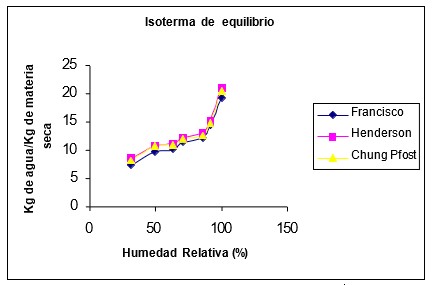
The knowledge of relation between seed water content and the air relative humidity value is necessary to study seeds sorption and desorption kinetics. These relations try out and important roll to selection of better conditions of temperature for dry and store. The seeds are hygroscopic, absorber and free humidity to depend on environment where they are. Its final humidity it’s stabilized when these seeds are exposed front to specific environment for determined time. In this test salts solutions were used and witch different relative humidity values (HR), such as permit to determine the equilibrium humidity of species. In this paper we determine the equilibrium humidity to different corn varieties (Zea maiz L) at different air relative humidity values to 30◦C. The experimental shapes were adjusted with the models of Chung-Pfost and Henderson.
Article Details

This work is licensed under a Creative Commons Attribution-NonCommercial 4.0 International License.
Those authors who have publications with this journal accept the following terms of the License Attribution-NonCommercial 4.0 International (CC BY-NC 4.0):
You are free to:
- Share — copy and redistribute the material in any medium or format
- Adapt — remix, transform, and build upon the material
The licensor cannot revoke these freedoms as long as you follow the license terms.
Under the following terms:
- Attribution — You must give appropriate credit, provide a link to the license, and indicate if changes were made. You may do so in any reasonable manner, but not in any way that suggests the licensor endorses you or your use.
- NonCommercial — You may not use the material for commercial purposes.
- No additional restrictions — You may not apply legal terms or technological measures that legally restrict others from doing anything the license permits.
The journal is not responsible for the opinions and concepts expressed in the works, they are the sole responsibility of the authors. The Editor, with the assistance of the Editorial Committee, reserves the right to suggest or request advisable or necessary modifications. They are accepted to publish original scientific papers, research results of interest that have not been published or sent to another journal for the same purpose.
The mention of trademarks of equipment, instruments or specific materials is for identification purposes, and there is no promotional commitment in relation to them, neither by the authors nor by the publisher.
How to Cite
References
Calderón, S, Cañet Félix, Leonor Pérez Ensayos de equilibrio higroscópico de soya, sorgo y frijol Tecnología de cosecha, beneficio y almacenamiento de granos básicos, 2000.
Calderón, S, ShagaroskyT, Hernandez, E, Veja, M Isotermas de equilíbrio de garbanzo Memórias del evento 35 aniversario II Liliana Dimitrova 959-7111-39-x. .
Ellis, RH. , Hong, T.D. and Roberts, E.H. A comparison of the low –moisture-content limit to logarithmic relation between seed moisture and longevity. Annals of Botany 61; 405-408.1989.
Fortes y Okos M R Drying Theorie their basis and limitations as applied to food and grains in: Advances in drying A.J. Publishing Corporation 1980, 301 pp.
Marques JA y Masal O, 1991 Principio de secado de granos psicometría higroscopia. Serie: Tecnología Poscosecha: 8 Oficina Regional de la FAO para América Latina y el Caribe 72 pp.
Vertucci, C. W. and Roos, EE. (1993): Theoretical basis of protocols for seed storage.
Plant Physiology 94; 1019-1023