
Cultivares tradicionales de frijol caballero (Phaseolus lunatus L.) provenientes de comunidades locales de Cuba con posibilidades de comercialización
Article Sidebar
Main Article Content
Abstract
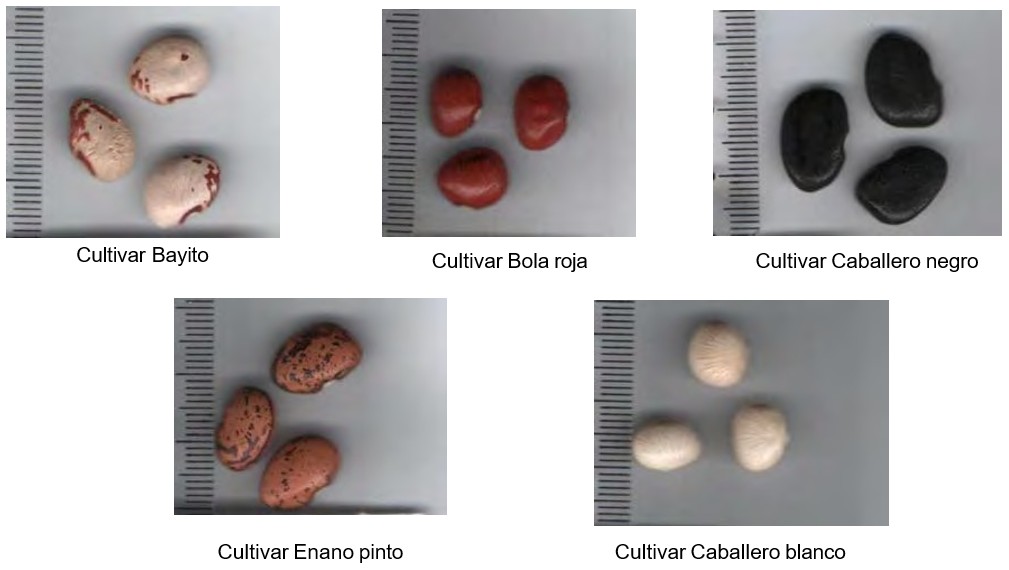
Phaseolus lunatus is an American crop and in some countries the seeds are national ant international commercialized, with considerable annual exportations. It is a neglected crop in Cuba and it has been poor utilized in genetic breeding programmes, however the seeds contribute, additionally, to the human diet in many rural communities, because its high proteins and soluble fibbers content. From the ex situ characterization was possible to select five varieties (Blanco, Negro, Bola Roja, Enano Pinto y Bayito), with different characteristics according to the colour, from and size of the seeds, which determine its elaboration for consumption. The potential yields are high; because of they can be considered as promised for the introduction to little scale in the productive practice. Those varieties came from the farmer fields linking to the Cuban Component of the Project “Assessment and adaptive management of seed systems and geneflow for sustainable agriculture in the humid tropics of Mexico, Cuba and Peru”. It had the technical and financial support of Bioversity International (former IPGRI) and IDRC. Between them stand out the cultivated variety: Enano Pinto, with determinate grow habit, a life cilcle of 96 to 104 days and yield of 25,5 g/plant alter two harvests, it has been in the Register of Commercial Varieties of Cuba for a farmer from La Munición Community, localized in Yateras, Guantánamo province, and it is sponsoring for INIFAT and USAG. This fact constitutes an advance step in the way of the diversity protection present in the local communities where they were originated.
Article Details

This work is licensed under a Creative Commons Attribution-NonCommercial 4.0 International License.
Those authors who have publications with this journal accept the following terms of the License Attribution-NonCommercial 4.0 International (CC BY-NC 4.0):
You are free to:
- Share — copy and redistribute the material in any medium or format
- Adapt — remix, transform, and build upon the material
The licensor cannot revoke these freedoms as long as you follow the license terms.
Under the following terms:
- Attribution — You must give appropriate credit, provide a link to the license, and indicate if changes were made. You may do so in any reasonable manner, but not in any way that suggests the licensor endorses you or your use.
- NonCommercial — You may not use the material for commercial purposes.
- No additional restrictions — You may not apply legal terms or technological measures that legally restrict others from doing anything the license permits.
The journal is not responsible for the opinions and concepts expressed in the works, they are the sole responsibility of the authors. The Editor, with the assistance of the Editorial Committee, reserves the right to suggest or request advisable or necessary modifications. They are accepted to publish original scientific papers, research results of interest that have not been published or sent to another journal for the same purpose.
The mention of trademarks of equipment, instruments or specific materials is for identification purposes, and there is no promotional commitment in relation to them, neither by the authors nor by the publisher.
How to Cite
References
Arnold, G.R.W. 1986. Lista de hongos fitopatógenos de Cuba. Ed. Científico-Técnica, ciudad de la Habana, 206 pp.
Castiñeiras, L.; R. Cristóbal, T. Shagarodsky, O. Barrios, L. Fernández, N. León, Z. Fundora-Mayor, V. Moreno, M. García, C. Giraudy, V. Fuentes, F. Hernández, D. Arzola, A. Rodríguez-Manzano, L. Walón, M. F. Pérez y D. de Armas. 2006a. Intercambio de semillas de frijol caballero (P. lunatus L.) en el sistema informal y su contribución al mantenimiento de la variabilidad in situ del cultivo en Cuba. Agrotecnia de Cuba 1. 2006a. La Habana.
Castiñeiras, L. y L. Walón. 2006b. Descriptor varietal de frijol caballero y habas lima (Phaseolus lunatus L.). Servicio de Inspección y Certificación de Semillas, Ministerio de la Agricultura, Ciudad de la Habana, 6 pp.
Castiñeiras L.; O. Barrios, L. Fernández, N. León, R. Cristóbal, T. Shagarodsky, V. Fuentes, Z. Fundora, V. Moreno, D. de Armas, G. Acuña, M. García, F. Hernández, D. Arzola y C. Giraudy. 2006c. Catálogo de cultivares tradicionales y nombres locales en fincas de las regiones occidental y oriental de Cuba: frijol caballero, frijol común, ajíes/pimientos y maíz. Instituto de Investigaciones Fundamentales en Agricultura Tropical “Alejandro de Humboldt”, Agrinfor, ISBN 959-246-183-X, La Habana, 64 pp.
CIDICCO, 2004. Phaseolus lunatus. Coberturas para la Agricultura, Tegucigalpa, 2 pp.
Fundora-Mayor; L. Castiñeiras, A. Rodríguez-Nodals, N. Companioni, R. Cristóbal, V. Fuentes, M. García, C. Giraudy, O. Barrios, T. Shagarodsky, L. Fernández, V. Moreno, R. Orellana y F. Hernández. 2006. Los cultivos sub-explotados: un tesoro para la diversificación con un papel decisivo en el contexto orgánico de producción. Agricultura Orgánica No 1, Año 12: 2-5.
IBPGR. 1982. Descriptors of Phaseolus lunatus. International Boar for Plant Genetic Resources. Roma, 36 pp.
Kashyap, R. K. y J. C. Duhan. 1994. Health status of farmers saved wheat seed in Haryana, India – a case study. Seed Science and Technology, 22: 619-628.
Matos Cuzcazo, G. y D. Zúñiga Dávila. 2002. Comportamiento de cepas nativas de rizobios aisladas de la costa del Perú en dos cultivares de pallar (Phaseolus lunatus L.). Ecología Aplicada 1(1): 19-24.
MINAG-Perú, 2005. Líneas de Cultivos Emergentes. Informe del Ministerio de la Agricultura de la República de Perú, Lima, 12 pp.