
Efecto fotoactivo de algunas plantas y sus posibilidades para el control de larvas de mosquitos
Article Sidebar
Main Article Content
Abstract
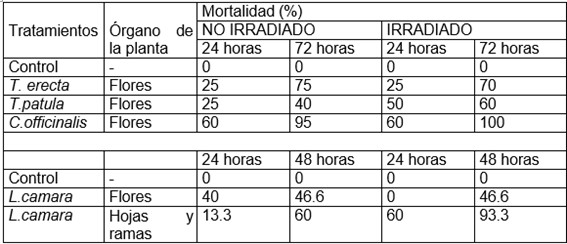
El comportamiento fotoactivo de determinados metabolitos de plantas está fundamentado en que ciertas moléculas absorben radiación luminosa y pasan a un estado de mayor energía o de excitación y, posteriormente, pueden regresar al estado inicial y así sucesivamente. Se conocen varias familias de plantas que producen metabolitos secundarios capaces de fotoactivarse, entre ellas sobresalen las Asteraceae que contienen thiophenos y polythiophenos como Alfa-Terthienyl, compuesto azufrado con un número variado de insaturaciones y cuya actividad fototóxica, en estado de excitación, es dependiente de la luz ultravioleta en rangos de 350-400 nanómetros Tomando en consideración estos antecedentes se estudió el efecto fototóxico de Tagetes erecta L., Tagetes patula Lin., y Calendula officinalis L. todas de la familia Asteraceae, así como Lantana camara L, de la familia Verbenaceae, contra larvas del mosquito Culex quinquefasciatus , indicador biológico utilizado para las pruebas. Se utilizaron, indistintamente, extractos acuosos de hojas, ramas y flores frescas de cada uno de los taxa; y se irradiaron a 350 y 400 nanómetros, utilizando el aditamento óptico de un espectrofotómetro CF-46 con tiempo de exposición de 15 y 30 minutos. El extracto fotoactivado se probó in vitro contra larvas de Culex quinquefasciatus Say (Diptera: Culicidae) del segundo estadio. Los extractos que mostraron los mejores resultados por esta vía fueron evaluados en una fuente UV de mayor capacidad de muestra a fin de corroborar la potencialidad fotoactiva de los mismos. Los resultados indicaron que los extractos de hojas y ramas de Lantana camara y las flores de Tagetes erecta y T. patula mostraron incremento de la bioactividad contra las larvas de Culex quinquefasciatus después de sometidas a la radiación UV con longitud de onda de 350-400 nanómetros y 15-30 minutos de exposición. En el caso de Tagetes erecta las flores color anaranjado fueron superiores a las de color amarillo, lo que puede estar relacionado con el contenido de flavonoides.
Article Details

This work is licensed under a Creative Commons Attribution-NonCommercial 4.0 International License.
Those authors who have publications with this journal accept the following terms of the License Attribution-NonCommercial 4.0 International (CC BY-NC 4.0):
You are free to:
- Share — copy and redistribute the material in any medium or format
- Adapt — remix, transform, and build upon the material
The licensor cannot revoke these freedoms as long as you follow the license terms.
Under the following terms:
- Attribution — You must give appropriate credit, provide a link to the license, and indicate if changes were made. You may do so in any reasonable manner, but not in any way that suggests the licensor endorses you or your use.
- NonCommercial — You may not use the material for commercial purposes.
- No additional restrictions — You may not apply legal terms or technological measures that legally restrict others from doing anything the license permits.
The journal is not responsible for the opinions and concepts expressed in the works, they are the sole responsibility of the authors. The Editor, with the assistance of the Editorial Committee, reserves the right to suggest or request advisable or necessary modifications. They are accepted to publish original scientific papers, research results of interest that have not been published or sent to another journal for the same purpose.
The mention of trademarks of equipment, instruments or specific materials is for identification purposes, and there is no promotional commitment in relation to them, neither by the authors nor by the publisher.
How to Cite
References
Armason, T., T. Swain, C-K. Wat, E. A. Graham, S. Partington, G. H. N. Towers y J. Lan (1981): Mosquito larvicidal activity of Polyacetylenes from species in Asteraceae. Biochem Syst. Ecol. 9,63
Borousky, D., J. R. Linley y J. Kagan (1987): Polycyclic aromatic compounds as phototoxic larvicides. J. Am. Mosq. Control Assoc. 3, 246.
Emsley, J. (1993): How sun-loving electron seek out weak bonds. New Scientist, 20pp.
Kagan, J., E. Kagan, S. Pastel, D. Perrine y V. Bindokas (1987): Light dependent effects of -Terthienyl in eggs, larvae and pupae of mosquito Aedes aegypti. J. Chem. Ecol. 13, 593.
Kagan, J., M. Jasón y F. Grynspan (1984): He inactivation of acetylcolinesterasa by -Terthienyl and ultraviolet light. Studies in vitro and in larvae of the mosquito Aedes aegypti. Biochem. Biophys. Acta 802, 442.
O´Brien, R.D. (1978): The biochemistry of toxic action of insecticide. Academic Press, Inc. New York, 515-539 pp.
Sinh, S. P., P. Sharma y L. K. Vats (1987): Lihgt-dependent toxicity of the extracts of Plant Tagetes erecta and -Terthienyl toward larvae of mosquito Culex tritaeniorhynchus. Toxic. Environ. Chem. 16, 81.