
Principal diseases in chickpea crop and their possible measures of control
Article Sidebar
Main Article Content
Abstract
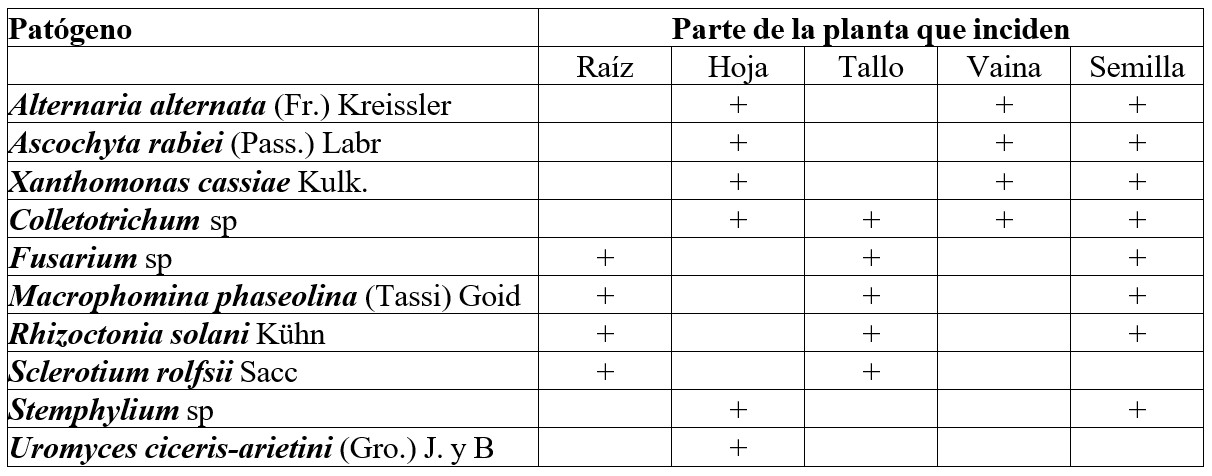
The first results of the evaluation and identification of diseases are presented in the chickpea crop (Cicer arietinum L.) in Cuba and their possible control measures. Samples of leaves shafts, roots and seeds with symptoms of plant pathogens microorganism we are taking and it used the conventional methodology for the isolation and identification of the species. Under laboratory conditions was evaluated the effect of eight fungicides applied to the seed for the control of Rhizoctonia solani and Fusarium spp. through the infestation index and the percentage of germination. The appropriate application doses for the most effective fungicides in the treatment to the seed were necessary to evaluate. Was studied the behaviour of four variants for the control of plant diseases from the field behaved in the seed. The results showed that the main diseases in the chickpea in Cuba are those caused by the Complex of Fungus of the soil among which Fusarium spp, Sclerotium rolfsii, Rhizoctonia solani and Macrophomina phaseolina and of them. The most important for the damages that take place and their frequency with which it is Fusarium spp. The treatment to the seed with the fungicides throws in a dose of 4 g of i.a / kilogram of seeds or Falisolan to reason of 3 g of a.i / kilogram of seed was effective in the control of the mushrooms of the soil. The application of systemic fungicides in the reproductive stage of the crop the indexes of infection of fungus that affect the quality of the seed and the yields and population crop level of chickpea diminish.
Article Details

This work is licensed under a Creative Commons Attribution-NonCommercial 4.0 International License.
Those authors who have publications with this journal accept the following terms of the License Attribution-NonCommercial 4.0 International (CC BY-NC 4.0):
You are free to:
- Share — copy and redistribute the material in any medium or format
- Adapt — remix, transform, and build upon the material
The licensor cannot revoke these freedoms as long as you follow the license terms.
Under the following terms:
- Attribution — You must give appropriate credit, provide a link to the license, and indicate if changes were made. You may do so in any reasonable manner, but not in any way that suggests the licensor endorses you or your use.
- NonCommercial — You may not use the material for commercial purposes.
- No additional restrictions — You may not apply legal terms or technological measures that legally restrict others from doing anything the license permits.
The journal is not responsible for the opinions and concepts expressed in the works, they are the sole responsibility of the authors. The Editor, with the assistance of the Editorial Committee, reserves the right to suggest or request advisable or necessary modifications. They are accepted to publish original scientific papers, research results of interest that have not been published or sent to another journal for the same purpose.
The mention of trademarks of equipment, instruments or specific materials is for identification purposes, and there is no promotional commitment in relation to them, neither by the authors nor by the publisher.
How to Cite
References
Avilés, M, K., J. J. Pérez, J. R. Manjarrez (1998) El cultivo del garbanzo blanco en el Centro de Sinaloa. Instituto Nacional de Investigaciones Forestales, Agrícolas y Pecuarias-Centro de Investigación Regional del Noroeste Campo Experimental Valle de Culiacán, México. Folleto para Productores No 41, 32 pp.
García, J. L. (1993): Estudio de las enfermedades del garbanzo (Cicer arietinum L.), su importancia y posibles medidas de control. Informe Final, INIFAT, 18 pp.
Gallegos, H. M. L.; E. L. Reynose y J. Oregam (1965): Observations on chickpea rust in Central Mexico. Phytopathology 55:125.
Greco, N. y Sharma, S. B. (1991): Proceedings of Second International Workshop on chickpea. ICRISAT, Hyderabad, India.
Govantes, F. y J.A. Montañes (1982): El cultivo del garbanzo. Hojas Divulgadoras 5. Ministerio de Agricultura, Pesca y Alimentación. España, 16pp.
Haware, M. y Y. Nene (1980): Influence of wilt at different stages on the yield loss in chickpea. Tropical Grain Legume Bull. (19):38-44.
Kaiser, W. J., Okhovat, M. y G. H. Mossahebi (1973): Effect of seed treatment fungicides on control of Ascochyta rabiei in chickpea seed infected with the pathogen. Plant Diseases Reporter 57: 742- 746.
Lukashevich, A.I. (1958): Control measures againts ascochytosis of chickpea. Journal of Agricultural Sci. Moscow 5: 131-135 (En Ruso) Abstract en Review of Applied Mycology 37:62, 1958.
*Mirta González Especialista en fitopatología del Departamento de Protección de Plantas del INIFAT durante el período de 1970 al 1995.
Nascimento, W. M.; H. B. S. Veiga y L. de Giordano (1998): Cultivo do grão de bico (Cicer arietinum L.). InstruÇoes Tecnicas da Embrapa HortaliÇas, 14, Centro Nacional de Pesquisa de HortaliÇas Diciembre, 10 pp.
Nene Y. L. (1980): Diseases of chickpea. Proceedings of International Workshop on Chickpea Improvement. ICRISAT, 28 Feb.- 2 Mar. 1979, Hyderabad, India. p 171-178.
Nene, Y. y M. Reddy (1987): Chickpea diseases and their control. En The Chickpea M.C. Saxena y K.B. Singh (eds.), CAB International Oxon, U. K. p 233-270.
Nene, Y., V. K. Sheila y S. B. Sharma (1989): Legumes Pathol. Prog. Rep., 7: 1-23.
Rangaswami, G. y N. N. Prasad (1960): A bacterial disease of Cicer arietinum L. Indian Phytopathology, 12: 172-175.
Reddy, M. V., K. B. Singh y Y. L. Nene (1982): Further studies of Calixin M in the control of seed-borne infection of Ascochyta in chickpea. International Chickpea Newsletter,6: 18-19.
Sattar, A. (1933): On the occurrence, perpetuation and control of gram Cicer arietinum L. Blight caused by Ascochyta rabiei (Pass.) Labrouse with special reference to Indian conditions. Annals of Applied Biology 20: 612-632.
Shagarodsky, T.; M. L. Chiang; M. Cabrera; O. Chaveco, M. R. López; B. Dibut; M. Dueñas; M. Vega y N. Permuy (2005): Manual de instrucciones técnicas para el cultivo del garbanzo (Cicer arietinum L.) en las condiciones de Cuba. INIFAT- MINAG, Holguín, 20 pp.
Singh K.B. y B.S. Dahiya (1973): Breeding for wilt resistance in chickpea. Symposium on wilt problems and breeding and breeding for wilt resistance in Bengal gram. Sept 1973, IARI, New Delhi, India p 13-14.
Singh, K. y M. Reddy (1991): Advances in diseases resistance breeding in chickpea. Advances in Agronomy 45:191-222.