
Cultivo de especies hortícolas en organoponía semiprotegida: densidad de siembra y manejo nutrimental
Article Sidebar
Main Article Content
Abstract
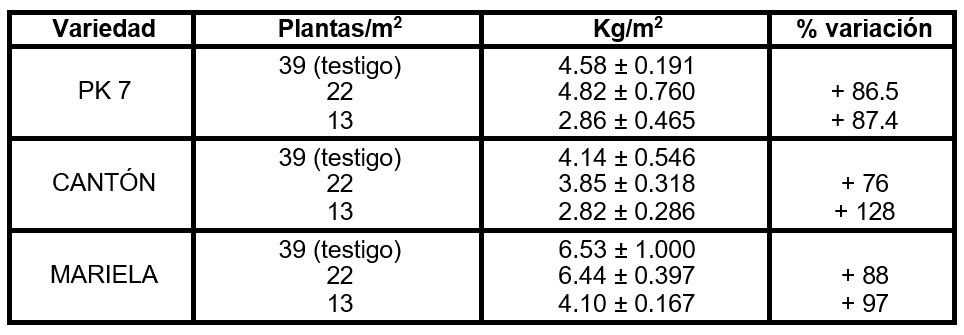
Pesponse of Brasssica rapa L. subsps. Lactuca sativa L. and Capsicum annuum L. to different sowing densities under covered organoponic conditions (reduction of 35% of sun incident radiation), was studied to identify the possible negative effects affecting plant development and production. Results indicate that, under shade conditions of the new agro technology, new concepts of nutritional and sowing management are necessary in order to guarantee high yields and for helping to prevent lacks of genetic attributes of cultivated species. To demonstrate that, a trial concerning bio organomineral nutrition management, pruning and high sowing density was carried out with Solanum lycopersicum L. as index plant, under the same agro technology conditions. Obtained data from hybrid HA 3057 and Cuban cultivar FI-5 indicate that it is possible to guarantee conditions for plants genetic and productive characteristics expression, by combining organic matter applications with mineral fertilizer and bio products based on microorganisms.
Article Details

This work is licensed under a Creative Commons Attribution-NonCommercial 4.0 International License.
Those authors who have publications with this journal accept the following terms of the License Attribution-NonCommercial 4.0 International (CC BY-NC 4.0):
You are free to:
- Share — copy and redistribute the material in any medium or format
- Adapt — remix, transform, and build upon the material
The licensor cannot revoke these freedoms as long as you follow the license terms.
Under the following terms:
- Attribution — You must give appropriate credit, provide a link to the license, and indicate if changes were made. You may do so in any reasonable manner, but not in any way that suggests the licensor endorses you or your use.
- NonCommercial — You may not use the material for commercial purposes.
- No additional restrictions — You may not apply legal terms or technological measures that legally restrict others from doing anything the license permits.
The journal is not responsible for the opinions and concepts expressed in the works, they are the sole responsibility of the authors. The Editor, with the assistance of the Editorial Committee, reserves the right to suggest or request advisable or necessary modifications. They are accepted to publish original scientific papers, research results of interest that have not been published or sent to another journal for the same purpose.
The mention of trademarks of equipment, instruments or specific materials is for identification purposes, and there is no promotional commitment in relation to them, neither by the authors nor by the publisher.
How to Cite
References
AROZARENA, N. J. (1999): Criterios para un manejo sostenible de la nutrición vegetal en la agrotecnología zeopónica. Tesis en opción al grado científico de Doctor en Ciencias Agrícolas. La Habana: INIFAT (MINAG).
AROZARENA, N. J. et al. (2007). Cultivo semiprotegido: evaluación de distancias de plantación para pimiento (Capsicum annuum, L.) en época óptima. Revista Agrotecnia de Cuba 31 (1, 2, 3),. ISSN: 05683114.
CASANOVA, A. et al. El cultivo protegido de hortalizas en Cuba: Estudio del túnel tipo "sombrilla". En: Ramírez, Neyda (ed). Producciones de cultivos en condiciones tropicales. --La Habana: Liliana, 1998, 49-51.
CASANOVA, A. S. et al. Manual para la producción protegida de hortalizas. –La Habana: LILIANA, 2003.
CRISTOBAL, R.; Melba Cabrera y Cecilia Díaz. Comportamiento del crecimiento de tres variedades de tomate (Lycopersicon esculentum Mill) al reducirse la radiación solar. En: Ramírez, Neyda (ed). Producciones de cultivos en condiciones tropicales. --La Habana: Liliana, 1998, 49-51.
PAPADOPOULOS, A. P. and X. M. Hao. Effects of three greenhouse cover materials on tomato growth, productivity and energy use. Scientia Horticulturae 70 (2-3): 165-178, 1997.
RODRÍGUEZ, A. A. et al. Manual técnico para organopónicos, huertos intensivos y organoponía semiprotegida. –La Habana: ACTAF/INIFAT, 2007.
SMITH, A. y J. San José. Productividad del maíz (Zea mays, L.) en las condiciones climáticas de los llanos altos centrales de Venezuela. II Crecimiento del híbrido OBREGÓN sembrado en la temporada seca. Agronomía Tropical. 29 (5): 439-451, 1979.
TITTONELL, P. A.; J. De Grazia y A. Chiesa. Adición de polímeros superabsorbentes en el medio de crecimiento para la producción de plantines de pimiento. Horticultura Brasilera. 20 (4): 22-28, 2002.