
Evaluation of plantation distances for gladiolus (Gladiolus spp) seed production
Article Sidebar
Main Article Content
Abstract
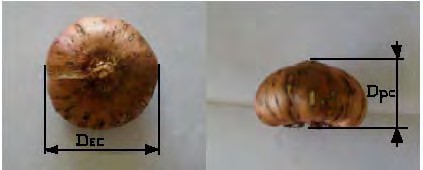
The experiment was carried out in areas at "Liliana Dimitrova" Horticultural Research Institute, in Quivicán, Havana, Cuba, the behaviour of three plantation distances, was evaluated: T1: 0.10 m, T2: 0.05 m and T3: 0.025 m among corms in the production of seeds of the gladiolus (Gladiolus spp), distributed at random in a design of blocks with three repetitions. They were carried out the following evaluations: equatorial and polar diameter of the corms, number of cormels, fresh weight of the cormels, fresh weight of the corms, multiplication rate and yield. The obtained results show the equatorial and polar diameter of the corms didn't present significant differences for the different studied variants and the values of the same ones oscillated among 4.68 - 4.47 cm and 2.50 - 2.28 cm, respectively. The quantity of cormels for corm presented significant differences in favour of 0.10 m of plantation among corms in connection with the rest of the treatments, with 29.19, 23.36 and 16.33 cormels for corm respectively. The multiplication rate was superior in the T1 with 2,6 and the yield presented statistical differences in favour of 0.025 m among corms without differing of the rest of the treatments with 31.07 t*ha-1.
Article Details

This work is licensed under a Creative Commons Attribution-NonCommercial 4.0 International License.
Those authors who have publications with this journal accept the following terms of the License Attribution-NonCommercial 4.0 International (CC BY-NC 4.0):
You are free to:
- Share — copy and redistribute the material in any medium or format
- Adapt — remix, transform, and build upon the material
The licensor cannot revoke these freedoms as long as you follow the license terms.
Under the following terms:
- Attribution — You must give appropriate credit, provide a link to the license, and indicate if changes were made. You may do so in any reasonable manner, but not in any way that suggests the licensor endorses you or your use.
- NonCommercial — You may not use the material for commercial purposes.
- No additional restrictions — You may not apply legal terms or technological measures that legally restrict others from doing anything the license permits.
The journal is not responsible for the opinions and concepts expressed in the works, they are the sole responsibility of the authors. The Editor, with the assistance of the Editorial Committee, reserves the right to suggest or request advisable or necessary modifications. They are accepted to publish original scientific papers, research results of interest that have not been published or sent to another journal for the same purpose.
The mention of trademarks of equipment, instruments or specific materials is for identification purposes, and there is no promotional commitment in relation to them, neither by the authors nor by the publisher.
How to Cite
References
Álvarez Pinto, M. (1980): Floricultura.Editorial Pueblo y Educación. C. Habana, 828 pp.
Black, C.A. (1965): Methods of soil analysis. Part II. Chemical and necrobiological properties. Agronomy Journal American Society of Agronomy. Inc. Publisher. Madison, Wisconsisn, USA, 25-31.
Bustos, P., V., Areas, C.E. Ñustez (1996): Interrelación de tubérculos en papa criolla (Solanum phureja Juz. et Buk) variedad ¨Yema de Huevo¨. Agronomía Colombiana, 13 (2): 162-168.
Fernández, A. (1999): Efecto del Biobras-6 en el crecimiento y desarrollo del ajo. Tesis en opción al grado de Master en Ciencia Biológicas. Universidad de la Habana, 54 pág.
Fernández. A., A. Casanova, E. Sotomayor, Misleidis Varona y Odalys Guarnial (2002): Influencia de la densidad de plantación y el calibre del cormo en la floración y producción e semillas del gladiolo (Gladiolus spp). Memorias XIII Congreso Científico INCA 12-15 nov.
Hernández, A. (1999). Nueva versión de la clasificación genética de los suelos de Cuba. MINAGRI. 64 pág.
Hernández. M. I., V. Marrero (2006): La fertilización del gladiolo. En: Aportes al conocimiento de la fisiología del crecimiento, la nutrición y la fertilización en cuatro especies de flores de corte para suelos ferralíticos. Instituto de investigaciones hortícolas Liliana Dimitrova. La Habana. p.21 – 26.
Le Nard, M. (1994): Bases biológicas para la producción y utilización de bulbos en ornamentales. Revista Chapingo: Serie Horticultura, 91: 35-44.
Marrero, V., M. I. Hernández, Yudiana Guerra, Martínez, A. Ojeda y J. Mc. Donald (2004): Efecto del tamaño del cormo en la calidad de la espiga y del material de propagación del gladiolo. En: XV Forum de Ciencia y Técnica. Programa y Resúmenes. La Habana: Instituto de Investigaciones Hortícolas “Liliana Dimitrova”. p.25
Marrero. V, M. Varona, M. Martínez, A. Hernández, Y. Acanda (2005): Manejo de la nutrición en el cultivo del gladiolo para semilla. En: XVI Forum de Ciencia y Técnica. Programa y Resúmenes. La Habana: Instituto de Investigaciones Hortícolas “Liliana Dimitrova”. p.40
Sigarroa, A. (1985): Biometría y diseño experimental. Ed. Pueblo y Educación, La Habana, 374 pág.