
Characteristics of three profiles of red lixiviated ferallític soils under natural forest conditions
Article Sidebar
Main Article Content
Abstract
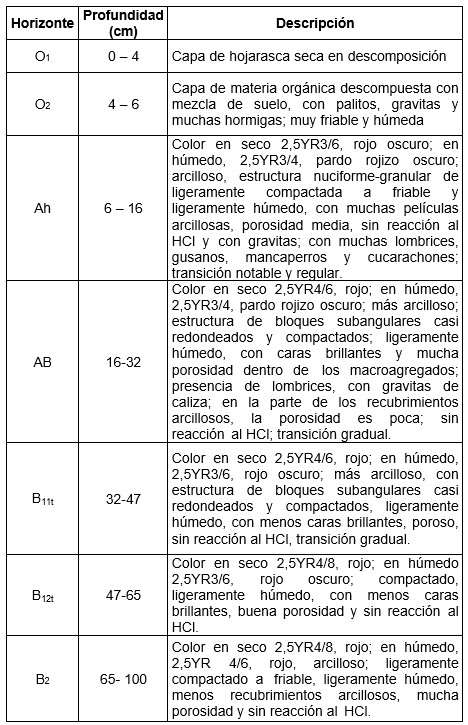
Ferralitic soils extend about 195 000 Ha in Havana province; the Red Lixiviated Ferralitic type is the most important one into this group of soils, because it represents the most extensive agriculture fund for the food production in Cuba. As these soils have been continuously cultivated for a very long time, lacks of their fertility and some changes in their principal properties have taken place, so it becomes important to study and characterize soils without these affectations in order to establish technical references (i. e.: pattern soil profiles) useful for the observation of cultivated soils transformations, because of agricultural activity. So, chemical and physical properties of three soil profiles, placed in forest and non-cultivated conditions, were evaluated to get information about their behavior, in natural or non-disturbed regime. The soil profiles were located in Havana (Agricultural Research National Institute/INCA) and Havana City (Tropical Agriculture Research Institute/INIFAT) Cuban provinces. Results show high contents of organic matter, low dispersion factor and bulk density; soils also have good structure and friable consistence, which means high productivity conditions. Evidence of gleyzation process was also observed.
Article Details

This work is licensed under a Creative Commons Attribution-NonCommercial 4.0 International License.
Those authors who have publications with this journal accept the following terms of the License Attribution-NonCommercial 4.0 International (CC BY-NC 4.0):
You are free to:
- Share — copy and redistribute the material in any medium or format
- Adapt — remix, transform, and build upon the material
The licensor cannot revoke these freedoms as long as you follow the license terms.
Under the following terms:
- Attribution — You must give appropriate credit, provide a link to the license, and indicate if changes were made. You may do so in any reasonable manner, but not in any way that suggests the licensor endorses you or your use.
- NonCommercial — You may not use the material for commercial purposes.
- No additional restrictions — You may not apply legal terms or technological measures that legally restrict others from doing anything the license permits.
The journal is not responsible for the opinions and concepts expressed in the works, they are the sole responsibility of the authors. The Editor, with the assistance of the Editorial Committee, reserves the right to suggest or request advisable or necessary modifications. They are accepted to publish original scientific papers, research results of interest that have not been published or sent to another journal for the same purpose.
The mention of trademarks of equipment, instruments or specific materials is for identification purposes, and there is no promotional commitment in relation to them, neither by the authors nor by the publisher.
How to Cite
References
Alfonso, C.A, 2002: Tecnología de manejo integrado de los suelos Ferralíticos Rojos degradados por compactación. Instituto de Suelos, Ministerio de Agricultura.
Alfonso, C. A. y Milagros Monedero 2004: Uso manejo y conservación de los suelos. ACTAF, ISBN: 959-246-122-8, La Habana, 68p.
Borges, Yenia 2006: Cambio de las propiedades de los suelos Ferralíticos Rojos Lixiviados por el cambio de uso de la tierra. Tesis de Universidad para Ingeniero Agrónomo, UNAH, La Habana, 87p.
Crawley J.T. 1916: Las Tierras de Cuba. Estación Experimental Agronómica de Santiago de las Vegas. La Habana. Editorial Rambla, Bouza y C., 81p.
Hernández, A., J. Paneque, J.M. Pérez, A. Mesa, y otros, 1995. Metodología para la Cartografía Detallada y Evaluación Integral de los Suelos. Instituto de Suelos, MINAG, La Habana, 55 p.
Cooper, M., P. Vidal-Torrado and V. Chaplot 2005. Originn of microaggregates in soils with ferralic horizons. Sci Agric., 62(3): 256-263,Piracicaba, Brazil.
Hernández, A., J.M. Pérez, D. Bosch, L. Rivero, 1999. Nueva Versión de Clasificación Genética de los Suelos de Cuba. Editorial AGRINFOR. ISBN: 959-246-022-1. Ciudad de La Habana, Cuba, 64p.
Hernández, A., M.O. Ascanio, M. Morales, F. Morell y Yenia Borges, 2006. Consideraciones sobre impactos de los Cambios globales en los suelos Ferralíticos Rojos Lixiviados (Nitisol ferrálico, éutrico, ródico) de la llanura roja de La Habana. Cultivos Tropicales 24(2):41-55.
Hernández, A., F. Morell, M. Morales, Y. Borges, D. López y otros, 2009a. “Cambios Globales en los Suelos Ferralíticos Rojos Lixiviados y Pardos Sialíticos inducidos por la acción antrópica”. Informe Final 2007-09. Proyecto PNCT 01304185. INCA. La Habana. 111p.
Hernández, M. Morales, F. Morell, Y. Borges, M.O. Ascanio, J.I. Bojórquez, R. Murray, H. Ontiveros, J.D. García, I. Gómez. 2009b. Changes in soil properties by agricultural activity in tropical ecosystems. Abstracts International Conference “Soil Gography:New Horizons”. Huatulco, Mexico.
Morell, F., A. Hernández, F. Fernández y Yuselín Toledo 2007. Caracterización agrobiológica de los suelos Ferralíticos Rojos Lixiviados de la región de San José de las Lajas, en relación con el cambio en el manejo agrícola. Cultivos Tropicales 27(4):13-18.
Morales, M., A. Hernández, F. Marentes, F. Funes-Monzote, Y. Borges, F. Morrell, D. Vargas y H. Ríos, 2008. Nuevos aportes sobre el efecto de la disminución de la Materia Orgánica en los suelos Ferralíticos Rojos Lixiviados, Agrotecnia de Cuba. Vol. 32 (2)57-64, MINAG, Ciudad de La Habana.
Orellana Gallego, Rosa y J.M. Moreno Álvarez 2001. Susceptibilidad de los suelos cubanos a la degradación. En Memoria XV Congreso Latinoamericano y V Cubano de la Ciencia del Suelo, Centro de Convenciones Plaza América, Varadero, Cuba.
Soil Survey Staff. 2006. Claves para la Taxonomía de Suelos. USA: USDA-NRCS, 331 pp.. UICS, Grupo de Trabajo del WRB, 2008. Base Referencial Mundial del Recurso Suelo. Informes sobre recursos mundiales de suelos, 103. FAO. ISRIC, 117p.