
Agrobiologic effect of phosphorous solubilizers microorganisms from acids soils
Article Sidebar
Main Article Content
Abstract
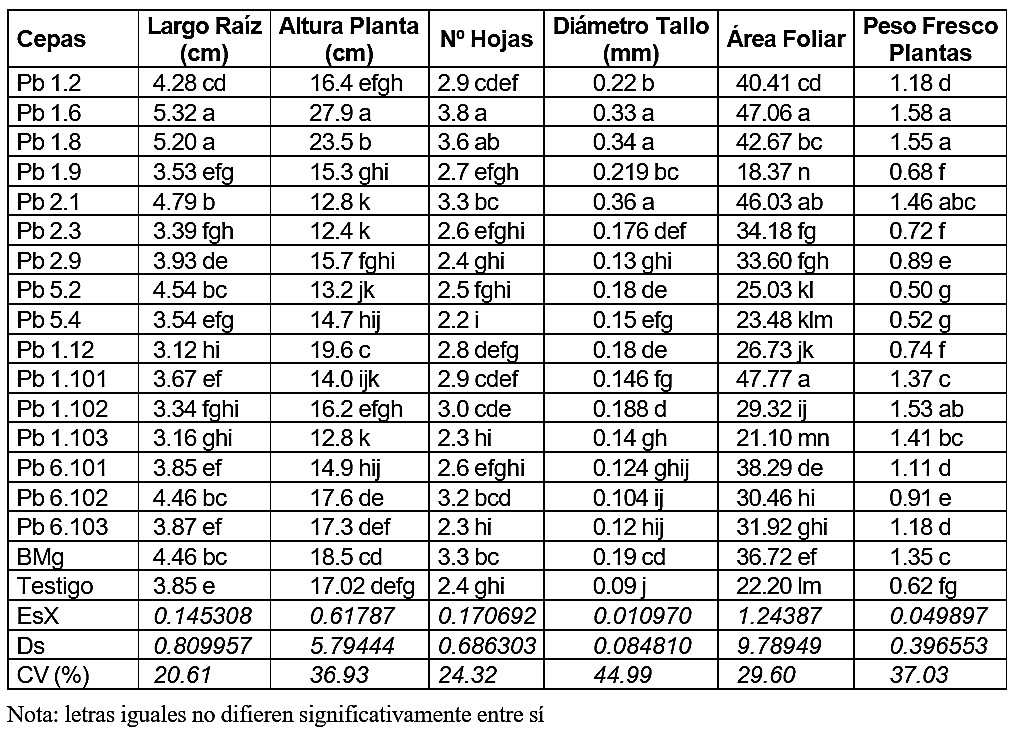
Microorganism isolation of acid soils is an important source to search new strains with hight potential for biofertilizer elaboration destinated for these specifics conditions. In order to make this work, samples of rhizospheric soils in different regions of Pinar del Río and Isla de la Juventud we taked and 78 bacteria strains were isolated. The potential of Phosphorous solubilizer in Pikovskaya medium with tricalcic phosphate supply to use three pH levels (5.5-6.3 and 7.0) were analyzed. Some of them, 22 isolated showed positive results and were selected four of them by solubilization power as promissory. Their effects in vegetables of tomato plants of 21 days of grow were determined by bioassays methods. Five were isolated by the values obtained over the indicators of growth and development parameters were selected. Morphology, Physiology and Biochemistry of characterization test from 22 solubilizer strains indicate that belong of Bacillus sp genus.
Article Details

This work is licensed under a Creative Commons Attribution-NonCommercial 4.0 International License.
Those authors who have publications with this journal accept the following terms of the License Attribution-NonCommercial 4.0 International (CC BY-NC 4.0):
You are free to:
- Share — copy and redistribute the material in any medium or format
- Adapt — remix, transform, and build upon the material
The licensor cannot revoke these freedoms as long as you follow the license terms.
Under the following terms:
- Attribution — You must give appropriate credit, provide a link to the license, and indicate if changes were made. You may do so in any reasonable manner, but not in any way that suggests the licensor endorses you or your use.
- NonCommercial — You may not use the material for commercial purposes.
- No additional restrictions — You may not apply legal terms or technological measures that legally restrict others from doing anything the license permits.
The journal is not responsible for the opinions and concepts expressed in the works, they are the sole responsibility of the authors. The Editor, with the assistance of the Editorial Committee, reserves the right to suggest or request advisable or necessary modifications. They are accepted to publish original scientific papers, research results of interest that have not been published or sent to another journal for the same purpose.
The mention of trademarks of equipment, instruments or specific materials is for identification purposes, and there is no promotional commitment in relation to them, neither by the authors nor by the publisher.
How to Cite
References
Bach, A. T y Díaz, M. (2008). Las Rizobacterias Promotoras del Crecimiento Vegetal (PGPR) en la agricultura. En: Agricultura Orgánica (3): 35-38. ISSN: 1028-2130.
Biu, H.; Hsiung, E. H.; Kwok, T. H and Ting, W. H. (2009). Microorganisms, microbial phosphate fertilizers and methods for preparing such microbial phosphate fertilizers. Patente Nº WO2009070966(A1).
Chen, Y. P.; Rekha, P. D.; Arun, A. B.; Shen, F. T.; Lai, W. A and Young, C. C. (2006). Phosphate solubilizing bacteria from sub-tropical soil and their tricalcium phosphate solubilizing abilities. In: Applied Soil Ecology 34: 33-41.
Chuang, Q. Z., y Wei, Y. H. (2006). Effects and mechanism of P-solubilizing Bacillus P-17 strain on phosphorous solubilization of different phosphate rocks. In: Acta Pedológica Sínica 41 (6): 931-937.
Elkoca, E.; Kantar, F. y Sahin, F (2008). Influence of Nitrogen fixing and phosphorus solubilizing bacteria on the nodulation, Plant Growth, and yield of Chickpea. In: Journal of Plant Nutrition 31(1): 157-171.
Hernández, J; D. Morales, G. Ascanio y P. Morell. (2007). Manual para la aplicación de la Nueva Versión de Clasificación Genética de los Suelos de Cuba. p. 1-3.
Holt, J.; Krieg, N.; Sneath, P.; Staley, J.; Williams, S. (1994). Bergey´s Manual of Determinative Bacteriology. Ten Edition.
Holt, J; N. Krieg, P. Sneath, J. Staley y S. Williams. (2004). «The genus Bacillus». In: Bergey’s Manual of Determinative Bacteriology. Ten edition. 35 p.
Janssen, P. H. (2006). Identifying the dominant soil bacteria taxa in libraries of 16S rRNA and 16S rRNA genes. In: Appl Environ Microbiol 72: 1719-1728.
López, M.; Martínez, V. R.; Brossard, F. M.; Bolívar, A.; Alfonso, N.; Alba, A y Pereira, H (2008). Efecto de biofertilizantes bacterianos sobre el crecimiento de un cultivar de maíz en dos suelos contrastantes Venezolanos. En: Agronomía Tropical 58 (4): 391-401.
Mantilla, C. M. E. (2007). Evaluación de la acción de un bioinoculante sobre un cultivo de Crisantemos en período de enraizamiento. Tesis en opción al título de Máster en Ciencias. Facultad de Ciencias de la Pontificia Universidad Javeriana. Colombia.
Martínez, V. R; López, M; Dibut, A. B; Parra, Z. C y Rodríguez, S. J. (2007). La fijación biológica del nitrógeno atmosférico en condiciones tropicales. Ed. MAT Caracas-Venezuela, 172 p.
Mehrvarz, S.; Chaichi, M. R and Alikhani, H. A. (2008). Effects of phosphate solubilizing microorganisms and phosphorous chemical fertilizer on yield and yield components of Barley (Hordeum vulgare L.). In: American-Eurasian Journal agriculture and Environment Sciencies. 3 (6): 822-828.
Pikovskaya, R. I. (1948). Mobilization of phosphorus in soil connection with the vital activity of some microbial species. In: Microbiologiya 17.
Rajankar, P. N.; Tambekar, D. H y Wate, S. R. (2007). Study of phosphate solubilization efficiences of fungi and bacteria isolated from saline belt of Purna river basin. In: Research Journal of Agriculture and Biological Sciences 3 (6): 701-703.
Tejeda, G. G (2010). Comunicación personal.