
Effectiveness of the management of the conservationist and the organ fertilization-mineral in the production of tomato and maize
Article Sidebar
Main Article Content
Abstract
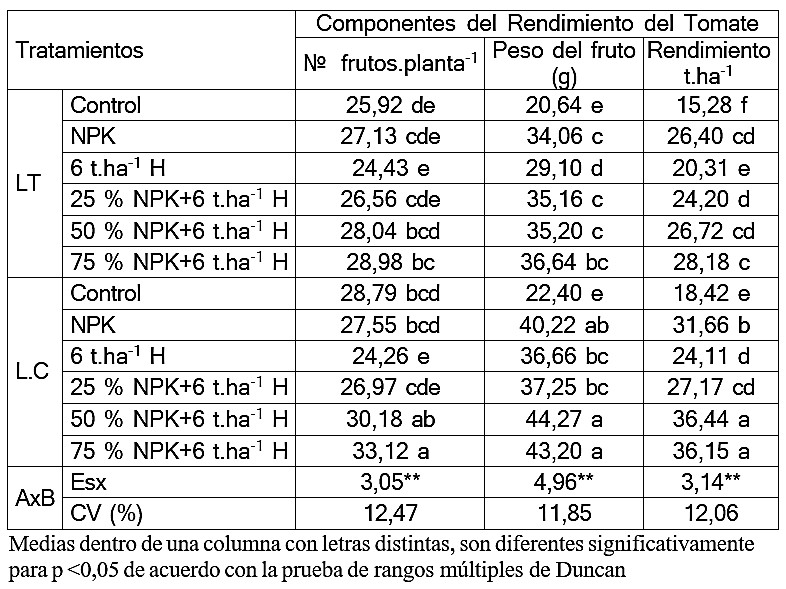
In area of Experimental Station «La Renee», located in Quivican municipality of Mayabeque province with representative soil of this region, it was carrying out one experience in the tomato-maize rotation which was applied two treatment A) two different tilling (traditional and minimum) and B) Six combination of mineral fertilization and vermicompost (control, high mineral fertilization, vermicompost (6 t ha-1), 25 % of high fertilization + vermicompost, 50 % of high fertilization + vermicompost and 75 % of high fertilization + vermicompost. The experience was organized as Randomized Complete block Design for factor A (technologies of tilling), with factor B (variants of fertilization) a split plot on A with four repetitions. The results demonstrated that the minimum tilling combined with media mineral fertilization + vermicompost and media- high mineral fertilization + vermicompost produced significant performances of the affected cultivations: Tomato 30.40 t. ha-1 and maize 2.3 t. ha-1, moreover, the quality of the tomato was favored in the content of vitamin C. These variant had a positive effect in the properties chemistries of the soils, specially, the contents of organic matter and the available forms of nitrogen, and potassium for these crops. The use of the minimum tilling and the organ fertilization-mineral constituted the base of a conservationist technology for the management of the fertility of Red Ferralitic Soils, and the sustainable production in a sequence of tomato and maize.
Article Details

This work is licensed under a Creative Commons Attribution-NonCommercial 4.0 International License.
Those authors who have publications with this journal accept the following terms of the License Attribution-NonCommercial 4.0 International (CC BY-NC 4.0):
You are free to:
- Share — copy and redistribute the material in any medium or format
- Adapt — remix, transform, and build upon the material
The licensor cannot revoke these freedoms as long as you follow the license terms.
Under the following terms:
- Attribution — You must give appropriate credit, provide a link to the license, and indicate if changes were made. You may do so in any reasonable manner, but not in any way that suggests the licensor endorses you or your use.
- NonCommercial — You may not use the material for commercial purposes.
- No additional restrictions — You may not apply legal terms or technological measures that legally restrict others from doing anything the license permits.
The journal is not responsible for the opinions and concepts expressed in the works, they are the sole responsibility of the authors. The Editor, with the assistance of the Editorial Committee, reserves the right to suggest or request advisable or necessary modifications. They are accepted to publish original scientific papers, research results of interest that have not been published or sent to another journal for the same purpose.
The mention of trademarks of equipment, instruments or specific materials is for identification purposes, and there is no promotional commitment in relation to them, neither by the authors nor by the publisher.
How to Cite
References
Alfonso, C. A. y M. Monedero. Uso, Manejo y Conservación de los Suelos. ACTAF. L a Habana, 66 p, 2004.
Calidad del Suelo. Determinación de formas móviles de Fosforo y Potasio. Oniani. NC: 52: 1999.
Calidad del Suelo. Determinación del pH y la Conductividad Eléctrica en el extracto de saturación.NC:32:2009.
Calidad del Suelo. Determinación del Nitrógeno total Método Kjeldahl. NC: 11261:2009.
Calidad del Suelo. Determinación de los componentes orgánicos (M.O). NC: XX 2010.
Calidad del Suelo. Determinación de los componentes orgánicos (C/N). NC: XX 2010.
Determinación de elementos totales. Humus de Lombbriz.NC: XX: 2009.
Duncan D. Multiple range and Multiple Test. Biometric. 1-8, 11-12.1954,
Fraser, Teresa, A. Vantour y Luz del Alba Mustelier. La fertilización órgano- mineral en la producción de tomate-boniato en suelos Ferralíticos Rojos. Sitio WEB de la Representación de la FAO en Cuba.(http:/ bva.fao.cu/).2011
Fraser, Teresa, A. Vantour y Luz del Alba Mustelier. La fertilización órgano-mineral en la producción de frijol-Maíz en suelos Ferralíticos Rojos. Sitio WEB de la Representación de la FAO en Cuba. (http:/ bva.fao.cu/). 2011.
Gutiérrez, N. C., J. R. Gutiérrez, y C. A. Venialgoch, Efectos de distintos sistemas de labranza y cultivos sobre la estabilidad de agregados y el contenido de materia orgánica, en un Haplustol Oxico. 1998. Citado en documento electrónico (ISO). pp. 5. 2004.
Hernández, A; J .M. Pérez; D. Bosch y L. Rivero. Instituto de Suelos. Nueva versión de clasificación genética de los suelos de cuba AGRINFOR, MINAGRI, Ciudad de la Habana, 64 p. 1999.
Instituto de Normalización. Norma cubana ICS: 13.080.10. 2ª edición. 2008.
John, Clara María, A. Vantour, L. González y A. Tamayo. Zonificación Agroecológica y Uso de los Fertilizantes Órgano-Minerales para mejorar la Fertilidad de los Suelos de la Empresa Militar del Oeste de La Habana. Informe Científico-Técnico, PRODESA S.A. La Habana, 25 p, 2011.
Luchsinger, A; R. Villa; G. Ocqueteau; F. Suter. Siembra con labranza tradicional y cero labranza, mediante la adaptación de una sembradora de cereales y dos distancias entre hileras en cultivares de frejol para verde y seco. IDESIA, Chile, 24(2):77-84, 2006.
Martínez, F., B. J. Calero, R. Nogales, y L. Revestí. Lombricultura. Manual práctico. Unidad de Producción Gráfica, MINREX, Ciudad de la Habana, Cuba. 99 p, 2003.
Mendoza, J. L. Sistema de Labranza Mínima en Maíz, Fríjol y Trigo. Campo Experimental Valle del Fuerte del INIFAP. www.youtube.com/watch?v=Z-b7KJHC1GQ27 Dic. 2008.
Molina, A. Influencia de tres tecnologías de preparación de suelo en el cultivo del frijol, variedad Bat–304 en un suelo ferralítico rojo de la zona sur de la provincia de Ciego de Ávila http://www.monografias.com/trabajos54/tecnologias-preparacion-suelo/tecnologias-preparacion-suelo2.shtml, 2006.
Sáenz Pena, R. Manual de sistema de labranza para América Latina. Boletín de Suelos de la FAO. 66. Roma. 192 p, 1992.
Stoffella, P. J y B. A. Kahn, utilización de compost en los sistemas de cultivo hortícola. mundi-prensa, Madrid, pp. 397, 2005.
Torres, D. Caracterización del Sistema de Producción de Brócoli y Efecto de la Fertilización Órgano-Mineral en la Dinámica del Nitrógeno. blibio. colpos. Mx, 2011.
Vantour, A., T. Fraser; M. Morales, C. M. John y D. Gómez; Tecnología Conservacionista para mejorar el rendimiento de una secuencia fríjol- Maíz-fríjol en suelos Vertisoles con problemas de salinidad del Valle del Cauto. En Programa y Resúmenes XIII Congreso Científico del INCA, San José, La Habana. p. 166. 2002.