
Cultivation and conservation of beans by scattered farmers in the Cuchillas del Toa Biosphere Reserve, evidence of climate change
Article Sidebar
Main Article Content
Abstract
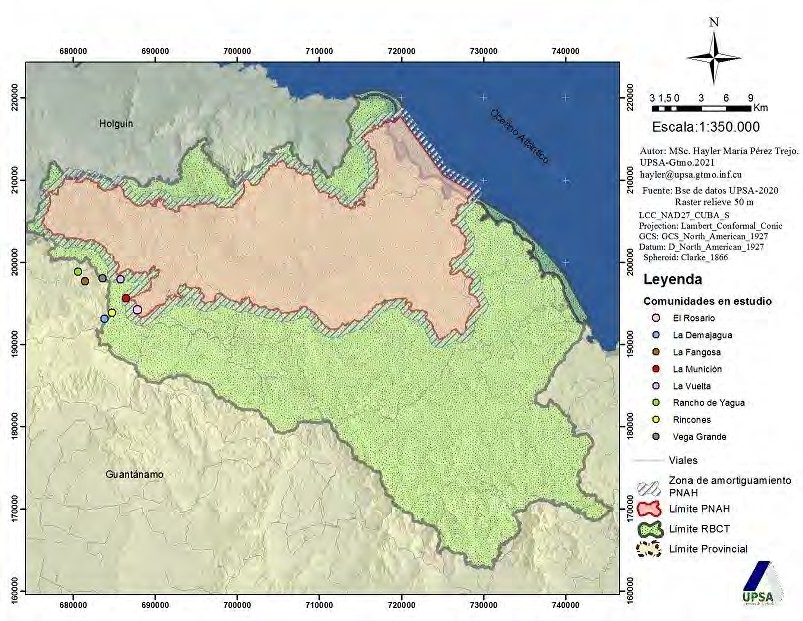
This research is carried out in the buffer zones of the Cupeyal del Norte conservation department, belonging to “Alejandro de Humboldt” National Park, the main nucleus of Cuchillas del Toa Biosphere Reserve. The communities belong to the municipalities of Manuel Tames Guerra and Yateras. One of the main problems in this context is the persistent weakness in seed conservation, therefore, the objectives were considered: to identify the traditional varieties of beans that these producers grow and conserve, as well as to analyze the behavior of rainfall in these localities with the support of traditional knowledge. The methodology used interviews, surveys and field forms for the collection of natural history information for the varieties in the study area. The results identified 13 varieties of common bean and eight among caupi, knight and gandul, the varieties of the highest frequency of appearance among producers, according to the size of the sample resulted: San Francisco 219® Rojo, which appears with four local names and its presence was 100%, as well as black beans with 95.4%.
Article Details

This work is licensed under a Creative Commons Attribution-NonCommercial 4.0 International License.
Those authors who have publications with this journal accept the following terms of the License Attribution-NonCommercial 4.0 International (CC BY-NC 4.0):
You are free to:
- Share — copy and redistribute the material in any medium or format
- Adapt — remix, transform, and build upon the material
The licensor cannot revoke these freedoms as long as you follow the license terms.
Under the following terms:
- Attribution — You must give appropriate credit, provide a link to the license, and indicate if changes were made. You may do so in any reasonable manner, but not in any way that suggests the licensor endorses you or your use.
- NonCommercial — You may not use the material for commercial purposes.
- No additional restrictions — You may not apply legal terms or technological measures that legally restrict others from doing anything the license permits.
The journal is not responsible for the opinions and concepts expressed in the works, they are the sole responsibility of the authors. The Editor, with the assistance of the Editorial Committee, reserves the right to suggest or request advisable or necessary modifications. They are accepted to publish original scientific papers, research results of interest that have not been published or sent to another journal for the same purpose.
The mention of trademarks of equipment, instruments or specific materials is for identification purposes, and there is no promotional commitment in relation to them, neither by the authors nor by the publisher.
How to Cite
References
Badstue, L.B.; Bellón, M.; Berthaaud, J.; Ramírez, A.; Flores, D. y Juárez, F. (2006). Collextiva action for the conservation of on-farm genetic diversity in a center of crop diversity: An assessment of the role of traditional farmer’s networks. CAPRI Working Paper # 38 IFPRI.
Begué-Quiala, G.; Shagarodsky, T.; Sánchez, Y.; Delgado, J.L.; Caraballo, O.; Rodríguez, G. y Pérez, H.M. (2019). Especies infrautilizadas de la agrobiodiversidad en la Reserva de Biosfera ¨Cuchillas del Toa¨, Guantánamo-Holguín. Agrotecnia de Cuba, 43 (1): 11-23. ISSN: 2414-4673.
Bollo, M. (1982). Compendio de Geografía de los suelos, La Habana, MES, Universidad de la Habana, Facultad de Geografía, 338 p.
Castiñeiras, L.; Barrios, O.; Fernández, L.; Cristóbal, R.; Shagarodsky, T.; Fuentes, V.; Fundora, Z.; Moreno, V.; de Armas, D.; Acuña, G.; García, M.; Hernández, F.; Arzola, D. y Giraudy, C. (2006). Catálogo de cultivares tradicionales y nombres locales en fincas de las regiones occidental y oriental de Cuba. Agrinfor. Ministerio de la Agricultura, 64 p.
CDB (Convenio sobre la Diversidad Biológica de las Naciones Unidas). (2017). 12. Principios de enfoques basados en ecosistemas. https://www.cbd.int/ecosistemas/.principle s.shtml. (Fecha de consulta: 2 de mayo de 2017).
CDB (Convenio sobre la Diversidad Biológica de las Naciones Unidas). (2016). Enfoque por ecosistemas. https://www.cbd.int/ecosystem/. (Fecha de consulta: 28 de marzo de 2017).
Fernández, L.; Shagarodsky, T.; Cristóbal, R.; Muñoz, L.; Gil, J.F.; Sánchez, Y.; González-Chávez, M.; Moreno, V.; Fundora, Z.M.; Castiñeiras, L.; León, N.; Rodríguez, A.A.; Acuña, G. y Walón, L. (2014). Catálogo de variedades. INIFAT, 165 p.
Jasso, A. (2019). Principio de conservación: coexistencia entre diversidad de especies comestibles y conocimiento tradicional. Polibotánica No. 47, México ene/jun. https://doi.org/10.18387/polibotanica.47. 13.
Lamin, N.G.; Miranda, S. y Ríos, H. (2005). Evaluación del impacto de la selección participativa de variedades de frijol (Phaseolus vulgaris L.) en La Palma, Pinar del Río. Cultivos Tropicales, 26(4): 89-94.
Lhumeau, A. y Cordero, D. (2012). Adaptación basada en Ecosistemas: una respuesta al cambio climático. UICN, Quito, Ecuador,17 p.
Planos, E.; Rivero, R. y Guevara, V. (2013). Impacto del Cambio Climático y Medidas de Adaptación en Cuba. Editorial AMA, 430 p.
Vega, J.; Alonso, A.; Leyva, A. y Beltrán (1997). Revisión bibliográfica agricultura tradicional: una vía para la conservación y el refugio de las especies. Cultivos Tropicales, 18(1): 58-61.
Vides, R. (2003). Primer Foro Nacional de Áreas Protegidas. UICN, Cochabamba, Bolivia.
Zabala, B. (2018). Ordenamiento ambiental de la Reserva de Biosfera Cuchillas del Toa. Tesis presentada en opción al Grado Científico de Doctor en Ciencias Geográficas, Universidad de la Habana. Facultad de Geografía,100 p.