
Productive response of habichuela (Vigna unguiculata L.) var. Canton -1 combined with the application and Fitomas®- Ecomic® E in intensive orchards conditions
Article Sidebar
Main Article Content
Abstract
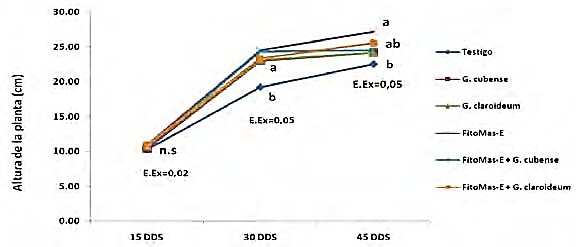
In order to evaluate the productive response in cultivation the Habichuela (Vigna unguiculata L.) var. Canton -1 upon the combined application of EcoMic® and FitoMas®- E, this research was developed in areas of intensive orchard "Margarita", in the municipality El Salvador, during the period from November 2013 to February 2014. Treatments distributed in three replicates in an experimental distributed block design, which consisted of a control treatment based organic matter (OM) at 5 kg.m2, the rest were formed by single and combined application (MO) 50% fractionated, Glomus cubense, Rhizophagus intraradices and FitoMas®-E for a total of six treatments. Plant height, number of pods, pod weight and yields: indicators were assessed. The results indicate that treatments combined with arbuscular mycorrhizal fungi and FitoMas® - E were the most beneficial from the standpoint of yields, achieving better response with combination FitoMas® - E and Glomus claroideum (3.5 kg. m2), with an additional income of $ 28 098.4.
Article Details

This work is licensed under a Creative Commons Attribution-NonCommercial 4.0 International License.
Those authors who have publications with this journal accept the following terms of the License Attribution-NonCommercial 4.0 International (CC BY-NC 4.0):
You are free to:
- Share — copy and redistribute the material in any medium or format
- Adapt — remix, transform, and build upon the material
The licensor cannot revoke these freedoms as long as you follow the license terms.
Under the following terms:
- Attribution — You must give appropriate credit, provide a link to the license, and indicate if changes were made. You may do so in any reasonable manner, but not in any way that suggests the licensor endorses you or your use.
- NonCommercial — You may not use the material for commercial purposes.
- No additional restrictions — You may not apply legal terms or technological measures that legally restrict others from doing anything the license permits.
The journal is not responsible for the opinions and concepts expressed in the works, they are the sole responsibility of the authors. The Editor, with the assistance of the Editorial Committee, reserves the right to suggest or request advisable or necessary modifications. They are accepted to publish original scientific papers, research results of interest that have not been published or sent to another journal for the same purpose.
The mention of trademarks of equipment, instruments or specific materials is for identification purposes, and there is no promotional commitment in relation to them, neither by the authors nor by the publisher.
How to Cite
References
Casanova, A.; Gómez, O.; Hernández, M.; Cayillos, M.; Depestre, T.; Pupo, F. 2006. Manual para la Producción Protegida de Hortalizas. Instituto de Investigaciones Hortícolas “Liliana Dimítrova”. Editorial Liliana, Ministerio de la Agricultura. La Habana Cuba.179 p.
MINAG. 1999. Nueva versión de clasificación genética de los suelos de Cuba. Instituto de Suelos. La Habana. Agrinfor. 64 p.
González-Leiva, M.; González, M.; Nápoles, E.; Baldoquín, A. 2012. Efectividad de algunos biofertilizantes en el cultivo del garbanzo (Cicer Arietinum, L.) en un suelo Fersialítico Pardo Rojizo Mullido. Innovación Tecnológica.18 (2):23- 27 p.
Hernández, C. L.; Hernández, N.; Soto, F.; Pino, M. A. 2010. Estudio fenológico preliminar de seis cultivares de habichuelas de la especie Phaseolus vulgaris L. Cultivos Tropicales. 31(1): 54-61 p.
Rivera, R.; Fernández, K. 2003. Manejo efectivo de la simbiosis micorrízica, una vía hacia la agricultura sostenible. Estudio de caso: el Caribe. Eds. INCA. La Habana., 166p.
Terry Alfonso, E.; Ruiz, J.; Tejeda P.; Tejeda, T.; Díaz- Armas, M. 2013. Respuesta del cultivo de la habichuela (Phaseolus vulgaris L. var. Verlili.) a la aplicación de diferentes bioproductos. Cultivos Tropicales. 2013. 34 (3): 5-10 p.
Avellan,J.; Díaz, M.; Marcelo, F.; Cueva, M.; Rivas, F. 2013. Eficiencia energética de la habichuela (Vigna unguiculata (L.) Walp. sub especie sesquipedalis). Centro Agrícola. 40 (2):91-92 p.
Rodríguez, A.; Martínez, F.; Ramos, L.; Cabrera, M.; Borrero, Y. 2011. Efecto del bioestimulante (FitoMas®-E) y el biofertlizante (bioplasma) en el rendimiento de la lechuga var. Anaida bajo condiciones de organoponía semiprotegida. Agrotecnia de Cuba. 35 (1): 54-60 p.
Ruiz, L.; Rivera, R.; Simó, J.; Carvajal, D. 2006. Nuevo método de inoculación con micorrizas en las raíces y tubérculos tropicales. XV Congreso del INCA. La Habana: INCA. 4 p.
González, N.; Pacheco, N.; Danger, L.; Jiménez, M. 2010. Respuesta agronómica de la habichuela variedad Cantón-1 a las aplicaciones de purines vegetales y bioestimulantes. Revista Electrónica Granma Ciencia.14 (2). ISSN 1027-975X.