
Response of tomato cultivars (Solanum Lycopersicum L.) under saline stress
Article Sidebar
Main Article Content
Abstract
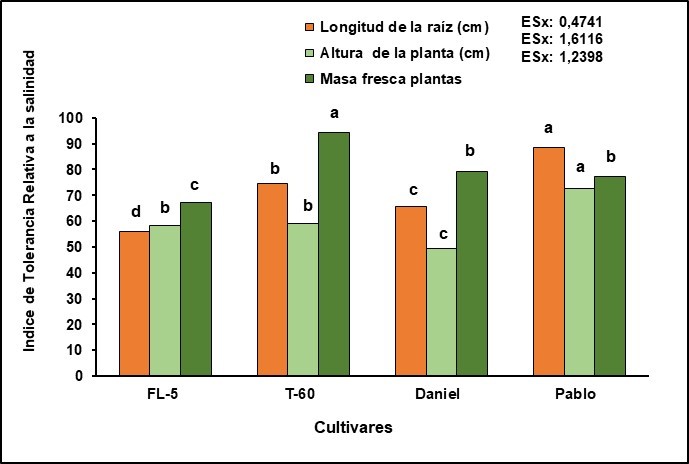
Currently, a wide range of stress affects many crops, among which salinity represents a serious problem in agriculture. Hence, it is necessary to study cultivars tolerant to these conditions for their inclusion in the country’s production systems. The objective of this work was to evaluate the relative salinity tolerance of selected tomato cultivars (Solanum lycopersicum L.) as a proposal for agroecosystems affected by this condition. Two trials were conducted: the first determined the germination percentage (GP) and the germination speed index (GSI), and the second trial calculated the relative salinity tolerance of the selected cultivars. Regarding GP and GSI, the cultivars ‘Daniel’, ‘Pablo’, ‘T-60’, and ‘FL-5’ stood out with superior results at a concentration of 50 mM NaCl, without significant differences between them, although differences were observed compared to the other evaluated cultivars. In terms of relative salinity tolerance at 50 mM NaCl, the cultivars ‘Pablo’ and ‘T-60’ excelled in most indicators evaluated, although ‘FL-5’ and ‘Daniel’ could also be used as strategies to diversify tomato cultivars under saline soil conditions.
Article Details

This work is licensed under a Creative Commons Attribution-NonCommercial 4.0 International License.
Those authors who have publications with this journal accept the following terms of the License Attribution-NonCommercial 4.0 International (CC BY-NC 4.0):
You are free to:
- Share — copy and redistribute the material in any medium or format
- Adapt — remix, transform, and build upon the material
The licensor cannot revoke these freedoms as long as you follow the license terms.
Under the following terms:
- Attribution — You must give appropriate credit, provide a link to the license, and indicate if changes were made. You may do so in any reasonable manner, but not in any way that suggests the licensor endorses you or your use.
- NonCommercial — You may not use the material for commercial purposes.
- No additional restrictions — You may not apply legal terms or technological measures that legally restrict others from doing anything the license permits.
The journal is not responsible for the opinions and concepts expressed in the works, they are the sole responsibility of the authors. The Editor, with the assistance of the Editorial Committee, reserves the right to suggest or request advisable or necessary modifications. They are accepted to publish original scientific papers, research results of interest that have not been published or sent to another journal for the same purpose.
The mention of trademarks of equipment, instruments or specific materials is for identification purposes, and there is no promotional commitment in relation to them, neither by the authors nor by the publisher.
How to Cite
References
Aazami, M. A., Rasouli, F., y Ebrahimzadeh, A. (2021). Oxidative damage, antioxidant mechanism and gene expression in tomato responding to salinity stress under in vitro conditions and application of iron and zinc oxide nanoparticles on callus induction and plant regeneration. BMC Plant Biology, 21(1). https://doi.org/10.1186/S12870-021-03379-7
Abdel-Farid, I., Marghany, M., Rowezek, M., y Sheded, M. (2020). Effect of salinity stress on growth and metabolomic profiling of Cucumis sativus and Solanum lycopersicum. Plants, 9(11), 1–19. http://www.horticultureresearch.net/
Abellón-Molina, M. I., Posada-Dacosta, M. D. G., Torres-Calzado, K., García-Reyes, R. A., Villazón-Gómez, J. A., y Velázquez-Sánchez, E. C. (2021). Remote sensing of salinity in agroecosystem of Mayarí, Holguín Province, Cuba. Revista Ciencias Técnicas Agropecuarias, 30(1), 26–32. http://eqrcode.co/a/Ho2rZmt
Aini, N., Dwi Yamika, W. S., y Setiawan, A. (2017). The role of salt (NaCl) stress on seed germination, growth and proline content of some tomato varieties. Journal of Applied Horticulture, 19(3), 245–248. http://www.horticultureresearch.net/
Ashraf, M. Y., Akhtar, K., Hussain, F., y Iqbal, J. (2006). Screening of different accessions of three potential grass species from Cholistan desert for salt tolerance. Pakistan Journal of Botany, 38(5), 1589–1597. https://doi.org/10.1007-4020-4018-0_3
Chakma, P., Hossain, M. M., y Rabbani, M. G. (2019). Effects of salinity stress on seed germination and seedling growth of tomato. Journal of the Bangladesh Agricultural University, 17(4), 490–499. https://doi.org/10.3329/jbau.v17i4.44617
Cortés, V. G., Alanoca, P. N., y Llave, M. C. (2014). Efecto de la salinidad sobre la germinación y crecimiento vegetativo de plantas de tomate silvestres y cultivada. Interciencia, 39(7), 511–517. https://www.redalyc.org/articulo.oa?id=33931446010
Delgado-González, C. R., Rodríguez-Laguna, R., Capulín-Grande, J., Madariaga-Navarrete, A., y Islas-Pelcastre, M. (2022). Caracterización fisicoquímica de suelos salinos agrícolas en la localidad de Chicavasco, estado de Hidalgo, México. South Florida Journal of Development, 3(1), 335–344. https://doi.org/10.46932/sfjdv3n1-026
Devi, N. D., y Arumugam, T. (2019). Screening of tomato genotypes at various levels of salinity. Journal of Pharmacognosy and Phytochemistry, 8(3), 3199–3201. http://www.phytojournal.com/archives/2019/vol8issue3/PartAT/8-3-219-706.pdf
Eitel, C. C. (2021). Efecto del estrés salino en la producción y calidad de semillas de tomate (Tesis de maestría). https://bibliotecadigital.oducal.com/Record/ir-11534-52676
Enríquez-Acosta, E. A., Ruiz-Espinoza, F. H., Carballo-Méndez, F. J., Beltrán-Morales, F. A., Vázquez-Vázquez, C., y García-Sánchez, H. D. (2023). El silicio como mitigador a salinidad en las variables fisiológicas de germinación de tres variedades de Solanum lycopersicum. Revista Mexicana de Ciencias Agrícolas, 14(1), 85–96. https://doi.org/10.29312/remexca.v14i1.3385
Estrada-Trejo, V., Lobato-Ortiz, R., García-de los Santos, G., Carrillo-Castañeda, G., Castillo-González, F., Contreras-Magaña, E., Ayala-Garay, O. J., De la O Olan, M., y Artola Mercadal, A. (2014). Diversidad de poblaciones nativas de jitomate para germinación en condiciones salinas. Revista Mexicana de Ciencias Agrícolas. 5(6), 1067-1079. https://doi.org/10.29312/remexca.v5i6.890
González, G. P., Suárez, N. T., y Marín, J. O. (2020). Effect of salinity and seed salt priming on the physiology of adult plants of Solanum Lycopersicum cv. Río Grande. Braz. J. Bot. 43(4):775-787. https://doi.org/10.1007/s40415-020-00636-1
Habib, S., Lwin, Y. Y., y Li, N. (2021). Article down-regulation of slgras10 in tomato confers abiotic stress tolerance. Genes, 12(5). https://doi.org/10.3390/genes12050623
Hameed, A., Ahmed, M. Z., Hussain, T., Aziz, I., Ahmad, N., Gul, B., y Nielsen, B. L. (2021). Effects of salinity stress on chloroplast structure and function. Cells, 10(8). https://doi.org/10.3390/CELLS10082023
Hernández Jiménez, A., López Pérez, D. y Morales Díaz, M. (2023). Métodos de análisis para calcular el contenido de sales de los suelos de Cuba. Agrotecnia de Cuba, 47(1), 93-97. https://agrotecnia.edicionescervantes.com/index.php/agrotecnia/article/view/19/13
Maguire, J. D. (1962). Speed germination-aid in selection and evaluation for seedling emergence and vigor. Crop Science, 2, 176-177. https://doi.org/10.2135/cropsci1962.0011183x00020002
Martínez-Sias, V. A., Martínez-Hernández, J. J., Zúñiga-Estrada, L., y Martínez-Montoya, J. F. (2022). Mejoradores de suelo salino-sódico y su efecto en el desarrollo de jitomate (Solanum lycopersicum). Ecosistemas y Recursos Agropecuarios, 9(1), e3086. https://doi.org/10.19136/era.a9n1.3086
Ortega-García, M., Ríos Rocafull, Y., Ortiz Núñez, Y., Fernández Granda, L., y Gil Vidal, J. F. (2025). Comportamiento de cultivares de tomate (Solanum lycopersicum L.) cubanos frente a diferentes condiciones de salinidad. Revista Agrisost, 31, 1–6. https://revistas.reduc.edu.cu/index.php/agrisost
Ruiz-Espinoza, F. H., Villalpando Gutiérrez, R. L., Murillo Amador, B., Beltrán Morales, F. A., y Hernández Montiel, L. G. (2014). Respuesta diferencial a la salinidad de genotipos de tomate (Lycopersicon esculentum Mill.) en primeras etapas fenológicas. Terra Latinoamericana, 32(4), 311–323. http://ref.scielo.org/yq4cm6
Ruiz-Sánchez, M., Muñoz-Hernández, Y., Guzmán, D., Velázquez-Rodríguez, R., Díaz-López, G. S., y Martínez, A. Y. (2018). Efecto del calibre de semilla (masa) en la germinación del sorgo. Cultivos Tropicales, 39(4), 51–59. https://ediciones,inca.edu.cu/index.php/php/ediciones/article/view/1480
Sangoquiza-Caiza, C. A., Viera-Tamayo, Y., Yánez-Guzmán, C. F., y Zambrano-Mendoza, J. L. (2021). Efecto del estrés salino sobre el crecimiento de plántulas de maíz variedad Tayuyo en condiciones in vitro. Revista Centro Agrícola, 48(2), 14–23, CF: cag022212318. http://cagricola.uclv.edu.cu/
Santoyo de la Cruz, M. F., Flores-Magdaleno, H., Khalil-Gardezi, A., Mancilla-Villa, Ó. R., y Rubiños-Panta, J. E. (2021). Composición iónica y comparación de índices de salinidad de suelo agrícola de Texcoco, México. Nova Scientia, 13(27), 1–20. https://doi.org/10.21640/ns.v13i27.2789
Soto-Cevallos, J. A. (2022). El cambio climático y su efecto en la biodiversidad. Revista de Ciencias Agropecuarias ALLPA, 5(10). https://doi.org/10.56124/allpa.v5i10.0051
Tahir, M., Zafar, M. M., Imran, A., Hafeez, M. A., Rasheed, M. S., Mustafa, H. S. B., Ullah, A., Saad, H. M., y Mustafa, B. (2018). Response of tomato genotypes against salinity stress at germination and seedling stage. Nature and Science, 16(4), 10–17. https://doi.org/10.7537/marsnsj160418.03
Thom, D., Taylor, A., Seidl, R., Thuiller, W., Wang, J., Robideau, M., y Keeton, W. (2021). Forest structure, not climate, is the primary driver of functional diversity in northeastern North America. https://doi.org/10.1016/J.SCITOTENV.2020.143070
Vázquez-Hernández, J. C., Mascorro Gallardo, J. O., Rodríguez Pérez, J. E., Castellanos, J. S., y Rodríguez de la O, J. L. (2023). Identificación de líneas de tomates silvestres tolerantes a salinidad en germinación y plántula. Revista Investigaciones y Estudios UNA, 14(1), 18–33. http://doi.org/10.57201/IEUNA2312777