
Fertilization with earthworm humus for the production of potato minitubers (Solanum Tuberosum L.)
Article Sidebar
Main Article Content
Abstract
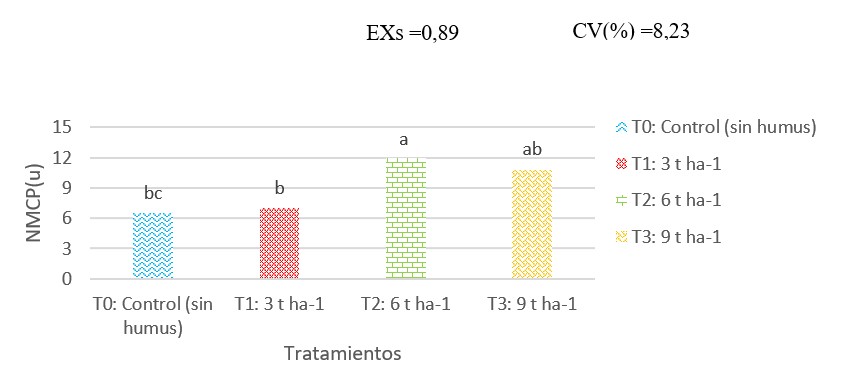
In Cuba, potato cultivation is an agricultural activity of strategic importance for food security and the local economy. Potato production from botanical seed can be utilized by producers in situ, as it enables them to dispense high quantities of fertilizers and pesticides. The objective of this study was to determine the appropriate application rates of earthworm humus fertilization for the production of potato minitubers as pre-basic seed, with the aim of achieving local multiplication of high-quality, well-adapted seed. The research was conducted between January and July 2024, in the Guisa municipality, Granma province. The cultivar 'Atzimba' was evaluated on a sloping brown soil without carbonates. Four treatments were established in a randomized complete block design with three replications: T1 (3 t ha⁻¹), T2 (6 t ha⁻¹), T3 (9 t ha⁻¹), and a control treatment without earthworm humus application. The agronomic variables measured were: polar and equatorial diameter of the minitubers, number of minitubers per plant, number of commercial minitubers per plant, and yield. Data were analyzed using ANOVA and a multiple comparison of means test (α = 0.05). Organic fertilization yielded the best results in T2, with a number of commercial minitubers per plant of 12 units and yield of 6.3 t ha⁻¹, significantly outperforming the control (6.5 units and 3.9 t ha⁻¹). No additional response was observed when the application rate was increased to 9 t ha⁻¹. It is concluded that the application of 6 t ha⁻¹ of earthworm humus constitutes the optimal rate for the sustainable production of pre-basic seed of the cultivar 'Atzimba' under mountain conditions, in Granma province.
Article Details

This work is licensed under a Creative Commons Attribution-NonCommercial 4.0 International License.
Those authors who have publications with this journal accept the following terms of the License Attribution-NonCommercial 4.0 International (CC BY-NC 4.0):
You are free to:
- Share — copy and redistribute the material in any medium or format
- Adapt — remix, transform, and build upon the material
The licensor cannot revoke these freedoms as long as you follow the license terms.
Under the following terms:
- Attribution — You must give appropriate credit, provide a link to the license, and indicate if changes were made. You may do so in any reasonable manner, but not in any way that suggests the licensor endorses you or your use.
- NonCommercial — You may not use the material for commercial purposes.
- No additional restrictions — You may not apply legal terms or technological measures that legally restrict others from doing anything the license permits.
The journal is not responsible for the opinions and concepts expressed in the works, they are the sole responsibility of the authors. The Editor, with the assistance of the Editorial Committee, reserves the right to suggest or request advisable or necessary modifications. They are accepted to publish original scientific papers, research results of interest that have not been published or sent to another journal for the same purpose.
The mention of trademarks of equipment, instruments or specific materials is for identification purposes, and there is no promotional commitment in relation to them, neither by the authors nor by the publisher.
How to Cite
References
Álvarez, C., Kari, A., Echegaray, N., Huaraca, R., Flores, N., y Barreto, J. (2022). Fertilización con humus de lombriz (Eisenia fetida) en el crecimiento vegetativo del cultivo de papa (Solanum tuberosum L.). C and T Riqchary, Revista de Investigación en Ciencia y Tecnología, 4(1), 39–45. https://doi.org/10.57166/riqchary/v4.n1.2022.87
Bardales, A. D. N., Muñoz Garay, S. G., Villanueva Tiburcio, J. E., Rojas Portal, R. M., Chamorro Gómez, R. E., Cueto Rosales, C. R., Bravo Romaina, J. M., Beraun Bedoya, J. R., y Mendoza Aguilar, A. (2022). Caracterización fisicoquímica de cuatro variedades de papas nativas (Solanum tuberosum) con aptitud para fritura, cultivadas en dos zonas en Huánuco. Revista de la Sociedad Química del Perú, 88(3), 237–250. https://doi.org/10.37761/rsqp.v88i3.400
Barghi, A., y Gholipoori, A. (2020). Variations of potato tuber yield and quality in response to vermicompost application and complete nanofertilizer. Journal of Vegetable Sciences, 4(7), 41-56. https://doi.org/10.22034/iuvs.2020.125590.1093
Bodor, K., Tamási, B., Len, A., Keresztesi, Á., Szép, R., y Bodor, Z. (2025). Investigation of the properties of different potato varieties and analysis of the starch structure. Applied Food Research, 5(1), 100998. https://doi.org/10.1016/J.AFRES.2025.100998
Chapman, H. D. (1965). Cation-exchange capacity. En C. A. Black (Ed.), Methods of soil analysis. Part 2. Chemical and microbiological properties (pp. 891-901). American Society of Agronomy. https://archive.org/details/methodsofsoilana0002blac
Food and Agriculture Organization of the United Nations. (2023). FAOSTAT: Food and agriculture data. https://www.fao.org/faostat/
Hernández, J., Pérez, J., Bosch, I., y Castro, S. (2015). Clasificación de los suelos de Cuba 2015. Cultivos Tropicales, 40(1). Ediciones INCA, Instituto Nacional de Ciencias Agrícolas e Instituto de Suelos. ISBN: 978-959-7023-77-7. https://www.inca.edu.cu
Huerta de la Cruz, A. J. (2022). Influencia del biocarbón elaborado con residuos sólidos orgánicos sobre la calidad y producción del cultivo de la papa en el Centro Experimental Ecológico de Tuyu Ruri. Aporte Santiaguino, 15(1), 149–163. https://doi.org/10.32911/as.2022.v15.n1.931
Instituto Nacional de Investigaciones en Viandas Tropicales (INIVIT). (2020). Boletín del INIVIT, 1(2020). http://www.inivit.cu/images/banners/Boletin_INIVIT_1_2020.pdf
Levene, H. (1960). Robust tests for equality of variances. En I. Olkin (Ed.), Contributions to probability and statistics: Essays in honor of Harold Hotelling (pp. 278–292). Stanford University Press.
López, Y., y Salomón, J. L. (2022). La reproducción de tubérculos de papa (Solanum tuberosum L.) a partir de su semilla sexual. Cultivos Tropicales, 43(1), e13. https://ediciones.inca.edu.cu/index.php/ediciones/article/view/1649
Malla, M., Tesema, G., and Hegano, A. (2021). Evaluation of vermicompost on growth, yield and yield components of potato (Solanum tuberosum L.) in Debub Ari Woreda, Southwestern Ethiopia. Journal of Science and Development, 9(1), 12-21. https://doi.org/10.20372/x5aqjq49
Ministerio de la Agricultura (MINAG). (2022). Informe preliminar de la campaña de papa 2021-2022. Dirección de Agricultura, La Habana, Cuba. https://www.minag.gob.cu/noticias/informe-preliminar-del-resultado-de-la-campana-de-papa-2021-2022/
Oficina Nacional de Estadística e Información (ONEI). (2021). Anuario estadístico de Cuba 2021: Capítulo Agricultura, ganadería, silvicultura y pesca. https://www.onei.gob.cu/anuario-2021
Olsen, S. R., Cole, C. V., Watanabe, F. S., y Dean, L. A. (1954). Estimation of available phosphorus in soils by extraction with sodium bicarbonate. USDA Circular No. 939. United States Department of Agriculture. https://books.google.com/books/about/Estimation_of_Available_Phosphorus_in_So.html?id=d-oaM88x5agC
Paneque Pérez, V. M., Calaña Naranjo, J. M., Calderón Valdés, M., Borges Benítez, Y., Hernández García, T. C., y Caruncho Contreras, M. (2010). Manual de técnicas analíticas para análisis de suelo, foliar, abonos orgánicos y fertilizantes químicos. Ediciones INCA. ISBN: 978-959-7023-51-7
Paneque Pérez, V. M., y Calaña Naranjo, J. M. (2004). Abonos orgánicos. Conceptos prácticos para su evaluación y aplicación. Ediciones INCA. ISBN: 978-959-246-121-5
Rodríguez, D., Uribe, P., and Benavides, C.A. (2023). Response of commercial potato genotypes Solanum tuberosum L. to Phytophthora infestans (Mont.) de Bary late blight attack. Revista de Ciencias Agrícolas, 40(1), e1200. https://doi.org/10.22267/rcia.20234001.200
Salman, A. D., Hussein, W. A., y Mhawesh, A. O. (2023). Improving mini tuber potato growth and yield by some plants' aqueous extract and earthworm compost. Anbar Journal of Agricultural Sciences, 21(2), 656-666. https://doi.org/10.32649/ajas.2023.144707.1098
Shapiro, S. S., y Wilk, M. B. (1965). An analysis of variance test for normality (complete samples). Biometrika, 52(3–4), 591–611. https://doi.org/10.2307/2333709
StatSoft, Inc. (2009). STATISTICA for Windows [Computer program manual]. Release.
Tukey, J. W. (1953). The problem of multiple comparisons [Manuscrito no publicado]. Department of Statistics, Princeton University. https://www.stat.berkeley.edu/~brill/Papers/tukey53.pdf
Velásquez, J., Araujo, A., Andrade, V., Rivadeneira, J., Cuesta, H., Racines, M. y Tinoco, K. (2022). Manual de producción de tubérculo-semilla de papa (Manual N.º 124, 2.ª ed.). Instituto Nacional de Investigaciones Agropecuarias. https://repositorio.iniap.gob.ec/handle/41000/6124
Vuković, A., Velki, M., Ečimović, S., Vuković, R., Štolfa Čamagajevac, I., y Lončarić, Z. (2021). Vermicomposting—Facts, Benefits and Knowledge Gaps. Agronomy, 11(10), 1952. https://doi.org/10.3390/agronomy11101952
Wylie, T., y Punja, Z. K. (2021). Assessing aerated vermicompost tea (ACT) combined with microbial biological control agents for suppression of Fusarium and Rhizoctonia. Phytopathology, 111(9), 1568-1577. https://doi.org/10.1094/PHYTO-05-20-0156-R
Yadava, L. P., Singh, J., Srivastava, D., Singh, S. P., Mishra, P. K., and Singh, H. D. (2024). Effect of humic acid and vermicompost on growth and yield of potato (Solanum tuberosum L.) cv. Chipsona-1. Plant Archives, 24(1), 93-100. https://doi.org/10.51470/PLANTARCHIVES.2024.v24.no.1.014