
Growth and nutrient uptake in cuatomate (Solanum glaucescens Zuc.) under different shade conditions and inoculation with arbuscular mycorrhizal fungi
Article Sidebar
Main Article Content
Abstract
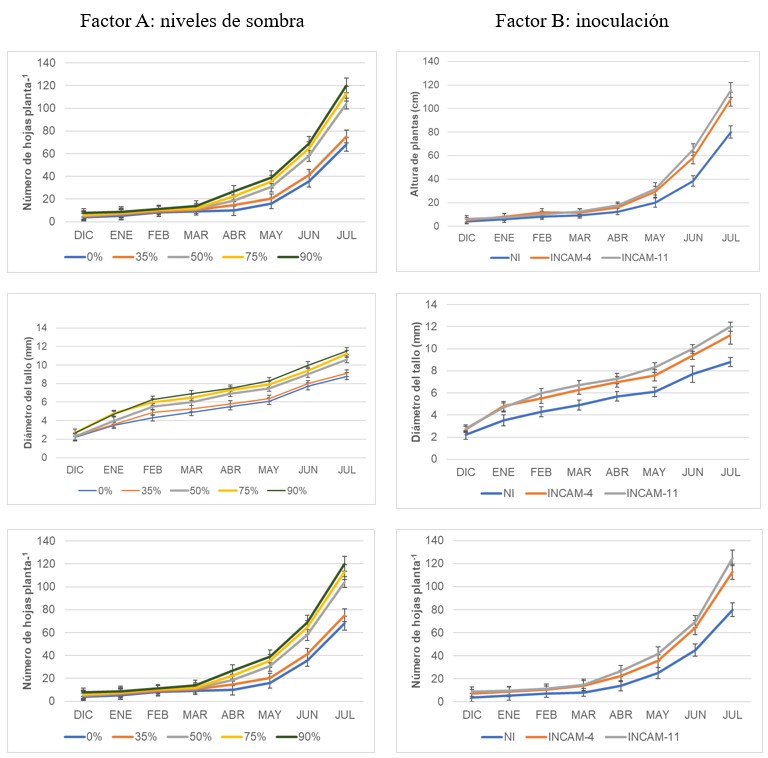
The cuatomate (Solanum glaucescens Zucc.) is a wild plant native to the deciduous forests of the Mixteca Baja region in Puebla, southern Mexico, whose fruits are locally valued. However, the lack of cultivation technologies limits its utilization despite increasing demand. The aim of this study was to evaluate, under greenhouse conditions, the effect of different levels of artificial shade and inoculation with arbuscular mycorrhizal fungi (AMF) on the growth and nutrient uptake of cuatomate. Five shading levels (0, 35, 50, 75, and 90%) were applied, either combined with the strains Glomus cubense and Rhizophagus irregularis, along with a non-inoculated control, under a completely randomized design with a factorial arrangement and 30 replications. Plant height, stem diameter, number of leaves, mycorrhizal variables, N, P, and K uptake by the aerial biomass, as well as air and soil temperature, relative humidity, and photosynthetically active radiation, were recorded monthly. No interaction between factors was detected; however, shading between 50 and 90% and AMF inoculation significantly promoted growth, mycorrhizal activity, and nutrient uptake from the fourth month of cultivation onward. Shading reduced air and soil temperatures, increased relative humidity, and decreased photosynthetically active radiation. It is concluded that, under greenhouse conditions, the combination of 50–90% shading and AMF inoculation favors the growth and nutrient absorption of cuatomate.
Article Details

This work is licensed under a Creative Commons Attribution-NonCommercial 4.0 International License.
Those authors who have publications with this journal accept the following terms of the License Attribution-NonCommercial 4.0 International (CC BY-NC 4.0):
You are free to:
- Share — copy and redistribute the material in any medium or format
- Adapt — remix, transform, and build upon the material
The licensor cannot revoke these freedoms as long as you follow the license terms.
Under the following terms:
- Attribution — You must give appropriate credit, provide a link to the license, and indicate if changes were made. You may do so in any reasonable manner, but not in any way that suggests the licensor endorses you or your use.
- NonCommercial — You may not use the material for commercial purposes.
- No additional restrictions — You may not apply legal terms or technological measures that legally restrict others from doing anything the license permits.
The journal is not responsible for the opinions and concepts expressed in the works, they are the sole responsibility of the authors. The Editor, with the assistance of the Editorial Committee, reserves the right to suggest or request advisable or necessary modifications. They are accepted to publish original scientific papers, research results of interest that have not been published or sent to another journal for the same purpose.
The mention of trademarks of equipment, instruments or specific materials is for identification purposes, and there is no promotional commitment in relation to them, neither by the authors nor by the publisher.
How to Cite
References
Ahmed, N, Li J., Li Y., Deng, L., Deng, L., Chachar, M., Chachar, Z., Chachar, S., Hayat, F., Raza, A., Umrani, J. H., Gong. L. y Tu, P. (2025). Symbiotic synergy: How arbuscular mycorrhizal fungi enhance nutrient uptake, stress tolerance, and soil health through molecular mechanisms and hormonal regulation. IMA Fungus 16: e144989. https://doi.org/10.3897/imafungus.16.144989
Aloud, S. S., Alotaibi, F., Sorrori, S. N. y Alshebe, B. (2025). Influence of rhizosphere dynamics and soil chemical properties in arid environments on the distribution, abundance, and diversity of arbuscular mycorrhizal fungi (AMF). Ecologies 6, 80. https://doi.org/10.3390/ecologies6040080
Chamard, J., Faticov, M., Guillaume, F. y Chagnon P. (2024). Interplay of biotic and abiotic factors shapes tree seedling growth and root associated microbial communities. Communications Biology, 7:360. https://doi.org/10.1038/s42003-024-06042-7
Fuller, D. Q., Denham, T. y Allaby, R. (2023). Plant domestication and agricultural ecologies. Current Biology 33, 636–649, https://doi.org/10.1016/j.cub.2023.04.038
Giovanetti, M., Mosse, B. (1980). An evaluation of techniques to measure vesicular-arbuscular infection in roots. New Phytologist, 84, 489-500. https://doi.org/10.1111/j.1469-8137.1980.tb04556.x
Guigard, L., Jobert, L., Busset, N., Moulin, L. y Czernic, P. (2023). Symbiotic compatibility between rice cultivars and arbuscular mycorrhizal fungi genotypes affects rice growth and mycorrhiza-induced resistance. Front. Plant Sci. 14: 1278990. https://doi.org/10.21203/rs.3.rs-2927360/v1
Hernández, R. C. J., Sandoval, C. E., Ocampo, M. J. y Casillas, C. L. (2020). Caracterización de frutos de cuatomate (Solanum glaucescens Zucc.) en el sistema de traspatio de la Mixteca Poblana. Estudios sociales. Revista de Alimentación Contemporánea y Desarrollo Regional, 30(55): 1-22. https://doi.org/10.24836/es.v30i55.830
Hernández, R. C. J., Zepeda. L. A., Ocampo, J., Sandoval, E. y Cruz, J. (2023). Dinámica de macronutrimentos en plantas de cuatomate (Solanum glaucescens Zucc., Solanales: Solanaceae) bajo condiciones protegidas. Acta Agrícola y Pecuaria 9: e0081002. https://doi.org/10.30973/aap/2023.9.0091002
Herrera, R. A., Furrazola, E., Valdés, A. R., Torres, Y., Ferrer, R. L. y Fernández, F. (1995). Estrategia de funcionamiento de las micorrizas VA en un bosque tropical. En: (Monasterio, M. ed.) Biodiversidad en Iberoamérica. Ecosistemas, Evolución y Procesos sociales. Programa Iberoamericano de Ciencia y Tecnología para el desarrollo. Subprograma XII Diversidad Biológica, Mérida, México.
INEGI. Anuario estadístico y geográfico de puebla (2017). https://www.inegi.org.mx/contenidos/productos/prod_serv/contenidos/espanol/bvinegi/productos/nueva_estruc/anuarios_2017/702825094973.pdf
IUSS Working Group WRB. World Reference Base for Soil Resources (2014). International soil classification system for naming soils and creating legends for soil maps. World Soil Resources Reports No. 106. FAO, Rome. https://openknowledge.fao.org/server/api/core/bitstreams/bcdecec7-f45f-4dc5-beb1-97022d29fab4/content
Lagos, B. T. C., Navia, E. J. F., Riascos, A. S. L. y Andrade, D. D. (2022). Estimación del área foliar en café variedad castillo con medidas lineales y su relación con el rendimiento. Revista Facultad de Ciencias Agropecuarias -FAGROPEC. Universidad de la Amazonia, 14 (1): 9-24. https://doi.org/10.47847/fagropec
López, S. G., Jiménez, C. F., Gómez, S. A., González, C. P. J., Jerez, M. E. y Medina, B. N. (2022). Compost application and biofertilization with arbuscular mycorrhizal fungi in cuatomate (Solanum glauscescens Zucc..) nursery. Cultivos Tropicales, Vol. 43(3). https://cu-id.com/2050/v43n3e04
Li, R., He, Y., Chen, J., Zheng, S. y Zhuang, C. (2023). Research progress in improving photosynthetic efficiency. Int. J. Mol. Sci. 24, 9286. https://doi.org/10.3390/ijms24119286
Mollericona, A. M. D., Laime, C. E. E.y Merma, S. E.A. (2022). Estimación no destructiva del área foliar en plántulas de cacao (Theobroma cacao L.) a partir de mediciones lineales en la hoja, Estación Experimental Sapecho. Apthapi, 8(1): 2310-2319. http://revistasbolivianas.umsa.bo/pdf/apt/v8n1/v8n1_a02.pdf
Payton, M. E., Miller, A. E. y Raun, W. R. (2000). Testing statistical hypotheses using standard error bars and confidence intervals. Commun. Soil Sci. Plant Anal. 31 (5-6): 547-551. https://doi.org/10.1080/00103620009370458 .
Rivera R, González P. J., Ruiz, L., Martín, G. M. y Cabrera, A. (2023). The Strategic combination of mycorrhizal inoculants, fertilizers and green manures improve crop productivity. Review of Cuban Research. En: Qiang-Sheng Wu, Ying-Ning Zou, Yue-Jun He et al. (Eds.). New Research on Mycorrhizal Fungus. ISBN: 979-8-88697-637-3 Nova Science Publishers, Inc.
Rodríguez, Y., Arias, L., Medina, A., Mujica, Y., Medina, L. R., Fernández, K. y Mena A. (2015). Alternativa de la técnica de tinción para determinar la colonización micorrízica. Cultivos Tropicales, 36 (2): 18-21. http://scielo.sld.cu/pdf/ctr/v36n2/ctr03215.pdf
Romero, C. A., Denham Vidal, F. R. E., Denham López, A. E., Denham Luna, E. N. y Escamilla, R. R. (2024). Caracterización física, química y funcional del fruto de cuatomate (Solanum glaucescens Zucc.) en dos estados de madurez. PSUMTEC, 7 (2), julio–diciembre, https://doi.org/10.61117/ipsumtec.v7i2.327
Rosales, P., González, P. J., Fundora, L. R. (2021). Respuesta del pasto Yacaré (Urochloa híbrido cv. CIAT BR02/1752) a la biofertilización con hongos micorrízicos arbusculares. Cultivos Tropicales, 42(1), e01. http://scielo.sld.cu/pdf/ctr/v42n1/1819-4087-ctr-42-01-e01.pdf
SPSS. Statistical software, version 25. (2017). SPSS Institute. Chicago, Illinois.
Simó, J., Rivera, R., Ruiz, L. y Martin, G. (2020). La integración de inoculantes micorrízicos, abonos verdes y abonamiento orgánico-mineral en plantaciones de bananos en suelos pardos. Tropical and Subtropical Agroecosystems, 23 (8). file:///C:/Users/x/Downloads/2882-13557-2-PB.pdf
Sun, Q., Lai, L., Zhou, J., Yi, S., Liu, X., Guo, J. y Zheng, Y. (2022). Differences in ecological traits between plants grown in situ and ex situ and implications for conservation. Sustainability, 14, 5199. https://doi.org/10.3390/su14095199
Tarakanov, I. G., Tovstyko, D. A., Lomakin, M. P.; Shmakov, A. S., Sleptsov, N. N., Shmarev, A. N., Litvinskiy, V.A. y Ivlev, A. A. (2022). Effects of light spectral quality on photosynthetic activity, biomass production, and carbon isotope fractionation in lettuce, Lactuca sativa L., plants. Plants, 11, 441. https://doi.org/10.3390/plants11030441
Trouvelot, A.; Kough, J. L. y Gianinazzi-Pearson, V. (1986). Mesure du taux de mycorhization VA d’un système radiculaire. Recherche de méthode d’estimation ayant une signification fonctionnelle. Physiological and genetical aspects of mycorrhizae. Proceedings of the 1st Symposium européen sur les mycorhizes. París: INRA. p. 217-221.
Valdebenito, A., Nahuelcura, J., Santander, C., Cornejo, P., Contreras, B., Gómez-Alonso, S. y Ruiz, A. (2022). Physiological and metabolic effects of the inoculation of arbuscular mycorrhizal fungi in Solanum tuberosum crops under water stress. Plants, 11, 2539. https://doi.org/x10.3390/plants11192539
Volis, S. (2023). Living collections of threatened plants in botanic gardens: when is ex situ cultivation less appropriate than quasi in situ cultivation? J. Zool. Bot. Gard.4, 462–475. https://doi.org/10.3390/jzbg4020034
Wu, Y., Chen, C. y Wang, G. (2024). Inoculation with arbuscular mycorrhizal fungi improves plant biomass and nitrogen and phosphorus nutrients: a meta-analysis. BMC Plant Biology, 24(1), 960. https://doi.org/10.1186/s12870-024-05638-9. ISSN: 1471-2229
Yang, J., Song, J. y Jeong, B. R. (2022). Lighting from top and side enhances photosynthesis and plant performance by improving light usage efficiency. Int. J. Mol. Sci., 23, 2448. https://doi.org/10.3390/ijms23052448
Zhang, J., Ge, J., Dayananda, B. y Li, J. (2022). Effect of light intensities on the photosynthesis, growth and physiological performances of two maple species. Front. Plant Sci. 13:999026. https://doi.org/10.3389/fpls.2022.999026