
Biological control of Macrophomina phaseolina (Tassi) using strains of Trichoderma ssp. and Cladobotryum semicirculare
Article Sidebar
Main Article Content
Abstract
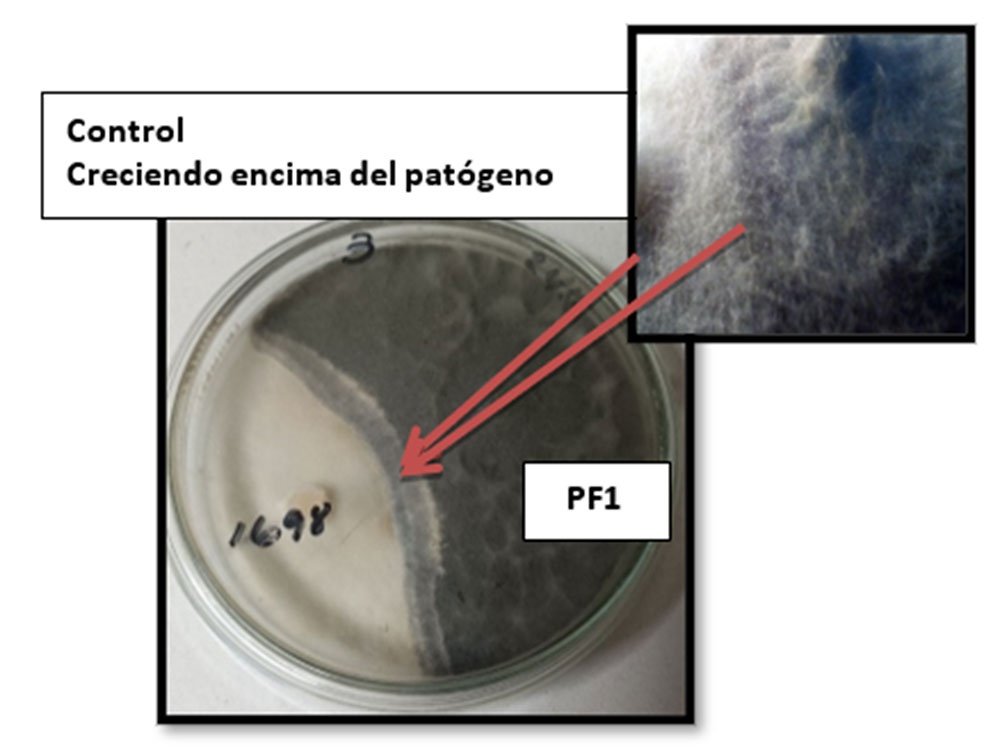
Macrophomina phaseolina is a soilborne phytopathogenic fungus with a wide distribution and host range, responsible for charcoal rot in more than 500 plant species, including agriculturally important legumes. In Cuba, its high incidence poses a challenge to the sustainable production of these crops due to the limited availability of effective and environmentally safe control methods. This study aims to evaluate in vitro the antagonistic effect of five strains of Trichoderma spp. and one strain of Cladobotryum semicirculare against M. phaseolina (strain PF1). The dual culture method was used to analyze three mechanisms of action: competition for space and nutrients, antibiosis, and mycoparasitism. The Trichoderma strains showed a high level of inhibition of the pathogen’s growth, while C. semicirculare demonstrated antagonistic potential through combined direct mechanisms. The results confirm the feasibility of using antagonistic fungi as a promising biological alternative for the integrated management of M. phaseolina in legume production systems.
Article Details

This work is licensed under a Creative Commons Attribution-NonCommercial 4.0 International License.
Those authors who have publications with this journal accept the following terms of the License Attribution-NonCommercial 4.0 International (CC BY-NC 4.0):
You are free to:
- Share — copy and redistribute the material in any medium or format
- Adapt — remix, transform, and build upon the material
The licensor cannot revoke these freedoms as long as you follow the license terms.
Under the following terms:
- Attribution — You must give appropriate credit, provide a link to the license, and indicate if changes were made. You may do so in any reasonable manner, but not in any way that suggests the licensor endorses you or your use.
- NonCommercial — You may not use the material for commercial purposes.
- No additional restrictions — You may not apply legal terms or technological measures that legally restrict others from doing anything the license permits.
The journal is not responsible for the opinions and concepts expressed in the works, they are the sole responsibility of the authors. The Editor, with the assistance of the Editorial Committee, reserves the right to suggest or request advisable or necessary modifications. They are accepted to publish original scientific papers, research results of interest that have not been published or sent to another journal for the same purpose.
The mention of trademarks of equipment, instruments or specific materials is for identification purposes, and there is no promotional commitment in relation to them, neither by the authors nor by the publisher.
How to Cite
References
Alizadeh, M., Khodadadi Manesh, S., Fathi, P. et al. (2025). Biology and Host Ranges of the Plant Pathogenic Fungus Macrophomina Phaseolina: a Comprehensive. Review. Journal of Crop Health, 77, 50 https://doi.org/10.1007/s10343-024-01106-4
Andrade-Hoyos, P.; Rivera-Jiménez, M. N., Landero-Valenzuela, N., Silva-Rojas, H. V., Martínez-Salgado, S. J. y Romero-Arenas, O. (2023). Beneficios ecológicos y biológicos del hongo cosmopolita Trichoderma spp. en la agricultura: una perspectiva en el campo mexicano. Revista Argentina de Microbiología, 55(4), 366-377. https://doi.org/10.1016/j.ram.2023.06.005
Atanasova, L.; Cromer, L.; Gruber, S.; Coulpier, F.; Seidl-Seiboth, V.; y Druzhinina, I. S. (2013). Comparative transcriptomics reveals different strategies of Trichoderma mycoparasitism. BMC Genomics, 14(1), 121. https://doi.org/10.1186/1471-2164-14-121
Banaras, S.; Javaid, A. y Khan, I. H. (2021). Bioassays guided fractionation of Ageratum conyzoides for identification of natural antifungal compounds against Macrophomina phaseolina. International Journal of Agriculture and Biology, 25(4), 761-767. https://doi.org/10.17957/IJAB/15.1727
Bell, D. K.; Wells, H. D. y Markham, C. R. (1982). In vitro antagonism of Trichoderma spp. against six fungal plant pathogens. Phytopathology, 72(4), 379-382. https://doi.org/10.1094/Phyto-72-379
Carreras Solís, B. (2018). Bioplaguicidas y biofertilizantes: Tendencia de uso en LABIOFAM, Cuba. CULCyT: Cultura Científica y Tecnológica, 15(66). https://dialnet.unirioja.es/servlet/articulo?codigo=7154513
Chávez-Díaz, I. F., Zelaya Molina, L. X., Cruz Cárdenas, C. I., Rojas Anaya, E. y Ruíz Ramírez, S. (2020). Consideraciones sobre el uso de biofertilizantes como alternativa agro-biotecnológica sostenible para la seguridad alimentaria en México. Revista Mexicana de Ciencias Agrícolas, 11(6), 1423-1436. https://doi.org/10.29312/remexca.v11i6.2492
Cortés-Hernández, F. C.; Alvarado-Castillo, G. y Sánchez-Viveros, G. (2023). Trichoderma spp., una alternativa para la agricultura sostenible: una revisión. Revista Colombiana de Biotecnología, 25(2), 73-87. https://doi.org/10.15446/rev.colomb.biote.v25n2.111384
Di Rienzo, J. A., Casanoves, F., Balzarini, M. G., González, L., Tablada, M., & Robledo, C. W. (2008). InfoStat, versión 2008 [Software]. Grupo InfoStat, Facultad de Ciencias Agropecuarias, Universidad Nacional de Córdoba, Argentina.
Díaz-Díaz, R.; Rodríguez, Y. y Pérez, M. (2022). Characterization of actinobacterial strains as potential biocontrol agents against Macrophomina phaseolina and Rhizoctonia solani, the main soil-borne pathogens of Phaseolus vulgaris in Cuba. Plantas, 11(5), 645. https://doi.org/10.3390/plants11050645
Flores-Moctezuma, E.; Gutiérrez-Morales, M. y Rodríguez-Castillo, F. (2022). Análisis de estudios de Trichoderma spp. como agente de control de fitopatógenos del suelo. Tropical and Subtropical Agroecosystems, 25(1), 1-12. https://www.revista.ccba.uady.mx/ojs/index.php/TSA/article/download/5914/2478
Jeyaseelan, E. C.; Tharmila, S. y Niranjan, K. (2012). Antagonistic activity of Trichoderma spp. and Bacillus spp. against Pythium aphanidermatum isolated from tomato damping-off. Archives of Applied Science Research, 4(4), 1623-1627. PDF disponible en Research Gate.
Lerch, G. (1977). La experimentación en las ciencias biológicas y agrícolas. La Habana, Cuba: Editorial Científico-Técnica.
Márquez, N.; Giachero, M. L.; Declerck, S. y Ducasse, D. A. (2021). Macrophomina phaseolina: General characteristics of pathogenicity and methods of control. Frontiers in Plant Science, 12, 634397. https://doi.org/10.3389/fpls.2021.634397
Pandey, A. K.; Basandrai, A. K.; Somta, P. y Basandrai, D. (2020). Macrophomina phaseolina-host interface: Insights into an emerging dry root rot pathogen of mungbean and urdbean, and its mitigation strategies. Plant Pathology, 70(6), 1263-1275. https://doi.org/10.1111/ppa.13378
Solórzano Arroyo, J. D. y Vargas-Chacón, R. (2021). Parasitismo in vitro de 23 aislamientos de Trichoderma asperellum contra Rhizoctonia solani y Fusarium oxysporum. Revista Alcances Tecnológicos, 14(1), 75-83. https://www.mag.go.cr/bibliotecavirtual/Ha-2021%28Ano14-N1%29p75.pdf
Vera Loor, M. E.; Rodríguez, M. A. y Cedeño, M. L. (2020). Evaluación in vitro de cepas de Trichoderma spp. como agentes de biocontrol mediante el método de cultivo dual. Revista Científica Agroecosistemas, 8(2), 45-53.
Vera, C.; Ramírez, D. y Ortega, M. (2025). Evaluación del efecto antibiótico in vitro de cepas de Trichoderma spp. frente a Fusarium oxysporum en cultivos duales. Revista Iberoamericana de Biocontrol Fúngico, 17(2), 23-31.
Vinale, F.; Sivasithamparam, K.; Ghisalberti, E. L.; Marra, R.; Woo, S. L. y Lorito, M. (2008). Trichoderma-plant-pathogen interactions. Soil Biology and Biochemistry, 40(1), 1-10. https://doi.org/10.1016/j.soilbio.2007.07.002
Zubieta-Coronado, D. A.; Echeverry-Prieto, L. C. y Zafra-Mejía, C. A. (2021). Antagonismo in vitro por consorcios de Trichoderma sp. y Aspergillus sp. contra el fitopatógeno Sclerotinia sp. Biotecnología en el Sector Agropecuario y Agroindustrial, 19(1), 16-31. https://doi.org/10.18684/bsaa.19.1.16