
Application of magnetic treatment on seed for the viability recovery.
Article Sidebar
Main Article Content
Abstract
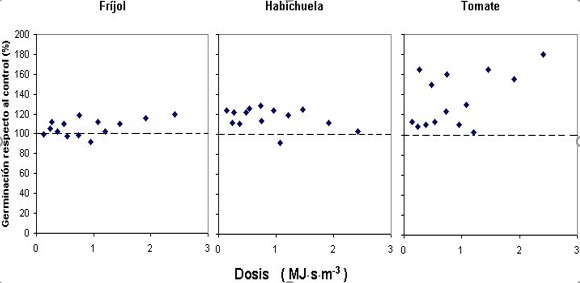
An experimental study of the magnetic treatment effects on seeds, to be applied for the viability recovery, is carried out in this paper. Plant species with relatively low values of seed viability were used: bean (Phaseolus vulgaris L.), Cv:CC-25N, asparagus bean (Vigna unguiculata (L.) Walt) Cv:Escambray 8-5 and tomato (Lycopersicon esculentum Mill.) Cv:INIFAT-28V. The treatments were applied at magnetic induction 75, 100, 125, 150, 175, 200 and 225 mT, at 1 and 2 minutes of exposure. The germination rehearsals were carried out seven days later regarding sowing in petri dishes with three replies of 50 seeds in each one and the non- parametric Duncan test was applied (a<0.05). Sesame seeds (Sesamum indicum L.), Cv: Aceitero to 100% germination were selected to the evaluation of magnetic treatment effects on the viability loss curve regarding the storage period. The studied cultivars manifested significant germination increments to regard the control. Stimulating effects of magnetic treatment on germination, regarding the control at a short term, were evidenced in the viability curves regarding the storage period, while
a significant inhibition at long term, was obtained. The water content evaluations on treated and control seeds during the aging showed significant differences, which support the hypothesis about permeability increments of water inside of the seed tissue due to magnetic field action.
Article Details

This work is licensed under a Creative Commons Attribution-NonCommercial 4.0 International License.
Those authors who have publications with this journal accept the following terms of the License Attribution-NonCommercial 4.0 International (CC BY-NC 4.0):
You are free to:
- Share — copy and redistribute the material in any medium or format
- Adapt — remix, transform, and build upon the material
The licensor cannot revoke these freedoms as long as you follow the license terms.
Under the following terms:
- Attribution — You must give appropriate credit, provide a link to the license, and indicate if changes were made. You may do so in any reasonable manner, but not in any way that suggests the licensor endorses you or your use.
- NonCommercial — You may not use the material for commercial purposes.
- No additional restrictions — You may not apply legal terms or technological measures that legally restrict others from doing anything the license permits.
The journal is not responsible for the opinions and concepts expressed in the works, they are the sole responsibility of the authors. The Editor, with the assistance of the Editorial Committee, reserves the right to suggest or request advisable or necessary modifications. They are accepted to publish original scientific papers, research results of interest that have not been published or sent to another journal for the same purpose.
The mention of trademarks of equipment, instruments or specific materials is for identification purposes, and there is no promotional commitment in relation to them, neither by the authors nor by the publisher.
How to Cite
References
Ellis, R.H.; Hong, T.D. and Roberts, E.H. 1985 Handbook of seed technology for genebanks. International Board for Plant Genetic Resources. 1-Principles and Methodology. Rome. 667 pp.
Fischler, M. 1993. Bean germoplasm conservation based on seed drying with silicageland low moisture storage. Occasional Publications Series (10). 31 pp
García, F. and Arza, L. 2001. Influence of a Stationary Magnetic Field on Water Relations in Lettuce Seeds. Part I: Theoretical Considerations. Bioelectromagnetics 22: 589-595
Golovina, E.A; Tikhonov, A. N. And Hoekstra, F. 1997.An Electron Paramagnetic Resonance Spin – Probe Study of Membrane – Permeability Changes with seed aging. Plant Physiology. 114(1): 383-389.
Lars, D2000. Cap. 8 Seed Storage. Extract from “Guide to Handling of Tropical and Subtropical Forest Seed”. www.dfsc.dk. 40 pp.
Martínez, E.; Carbonell, M. V. y Duarte, C. 1999.Efecto del tratamiento magnético en la germinación del arroz (Oriza sativa L.). Alimentaria. Julio-agosto: 95-99.
Pietruszewski, S. 1996. Effects of magnetic bioestimulation of wheat seeds on germination, yield and proteins. Agrophysics, 18-2 (10): 51-55
Socorro, A.; Pérez, S.; Hernández, E.; Martínez, E.; Carbonell, V. y Amaya, J.M. 2002. Incremento de la calidad de las semillas mediante el empleo del magnetismo. (13: 2002, nov 12-15, La Habana) Memorias. CD-ROM. Instituto Nacional de Ciencias Agrícolas. ISBN 959-7023-22-9.
Socorro, A., Pérez, S., Martínez, E., Carbonell, M.V., Amaya, J.M. y Hernández, E. 2004. Estudio de los Efectos Estimuladores del Tratamiento Magnético de Semillas en especies de Interés Agrícola. Memorias del evento Trópico 2004. II Congreso de Agricultura Tropical. ISBN 959-7167-02-6.
Walters, C.; Kameswara, N. and Xiaorong, H.1998. Optimizing seed water content to improve longevity in ex situ genebanks. Seed Science Research 8(1):12-22.