
The scientific development history of nematology in the INIFAT.
Article Sidebar
Main Article Content
Abstract
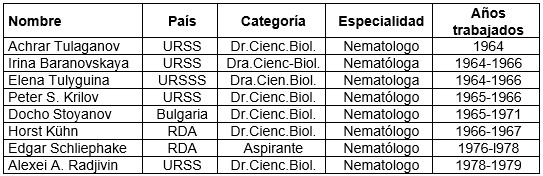
Valuable information of gain, results, and the trajectory of relevant scientists and researchers from the old Agronomic Experimental Station, actual Fundamental Research Institute of Tropical Agriculture (INIFAT), during many years has been accumulated. When its celebrated 100 years since this institution was created, it will be informed the emerging of nematological area, its main researchers, the more relevant jobs, the main investigated culture and the achieved gains. The historic caudal of this institution, after a hard work in the archives, by the revision of booklets, files, information, serial reviews, books, scientific booklets, and interview to worker since 35 or more years in the institution the institution, was achieved. Very interesting information and reveler, on the foundation of the nematological areas in 1964, was obtain; and the relevant work and assessory from specialists as Irina Baranovskaya, Alexei A. Radjivin, Docho Stoyanos, Frank Kühn, Modesto Fernández and a collaborator group. In tuber crops, serials, vegetables, and wild plants, has been worked. In the control, the resisting one, the main hosts, the distribution, the damage, the systematic and economic importance of the nematodes, also has been worked. More than 100 species related to those crops, including about 20 of them were new reports for the international science.
Article Details

This work is licensed under a Creative Commons Attribution-NonCommercial 4.0 International License.
Those authors who have publications with this journal accept the following terms of the License Attribution-NonCommercial 4.0 International (CC BY-NC 4.0):
You are free to:
- Share — copy and redistribute the material in any medium or format
- Adapt — remix, transform, and build upon the material
The licensor cannot revoke these freedoms as long as you follow the license terms.
Under the following terms:
- Attribution — You must give appropriate credit, provide a link to the license, and indicate if changes were made. You may do so in any reasonable manner, but not in any way that suggests the licensor endorses you or your use.
- NonCommercial — You may not use the material for commercial purposes.
- No additional restrictions — You may not apply legal terms or technological measures that legally restrict others from doing anything the license permits.
The journal is not responsible for the opinions and concepts expressed in the works, they are the sole responsibility of the authors. The Editor, with the assistance of the Editorial Committee, reserves the right to suggest or request advisable or necessary modifications. They are accepted to publish original scientific papers, research results of interest that have not been published or sent to another journal for the same purpose.
The mention of trademarks of equipment, instruments or specific materials is for identification purposes, and there is no promotional commitment in relation to them, neither by the authors nor by the publisher.
How to Cite
References
Acuña, G. J.1966.: El plátano, algunos aspectos botánicos. Enfermedades, Plagas y nematodos. Estación Experimental Agronómica, Santiago de las Vegas, Circular No.96.
Archivo histórico del Instituto de Investigaciones Fundamentales en Agricultura Tropical. Expediente personal de: S., C. Bruner, Legajo: 2, Expediente: 62, 1915.
Archivo histórico del Instituto de Investigaciones Fundamentales en Agricultura Tropical. Expediente personal de: J.A. Galé, Legajo: 1, Expediente: 1, 1922.
Bruner, S.C.: La Buba Blanca, Revista Agricultura Comercio y Trabajo.
Bruner, S.C.: La Maruca o taladrador de las vainas. Historia y distribución. Estación Experimental Agronómica, Santiago de las Vegas. Boletín No. 56 p- 12, 1935.
Cardín, P. Informe Anual 1909-1914 (3er. Informe) p-168, Estación Experimental Agronómica de Santiago de las Vegas.
Cuadra, M. R1980. Efectos de algunos cultivos sobre la población de Heterodera amaranthi en el suelo. Revista Ciencias de la Agricultura .No.5, p: 23-30.
Cuadra, M.R., Quincosa, A.1982. Comportamiento de diferentes especies de Psidium como patrón para el guayabo resistente a Meloidogyne (Nematodo Heteroderidae). Revista Ciencias de la Agricultura. No.13, p: 19-26.
Cuadra, M.R., Razjivin, A.1982.: Fitonematodos del tomate en algunas zonas de la Provincia Habana. Revista Ciencias de la Agricultura .No.11, p: 3-13.
Cuadra, M.R., Xiomara Cruz, Fajardo, J, 2000. Cultivos de ciclo corto como plantas trampas para el control del nematodo agallador. Nematrópica, Vol.30 No.2, p: 241-246.
Cuadra, M.R. 1980. Efecto de algunos cultivos, sobre la población de Heterodera amaranthi (NematodaÑ Heteroderidae), en el suelo. No.5 p: 23-30.
Fernández, M.1975. El Psidium friedrischthalianum como patrón para el guayabo, resistente a los nematodos. Revista de Agricultura Vol. VIII, No.3.
Fernández, M, 1970.: Listado de nematodos fitoparasíticos de Cuba (segunda contribución). Revista de Agricultura Vol. XI, No.1, p: 62-84.
Fernández M.1967. Lista de nematodos de Cuba (primera contribución) Revista de Agricultura Vol.1, No.2, p 74-88.
Fernández, M., Ortega, J.1982: Comportamiento de las poblaciones de nematodos fitoparásitos en plátano enano Cavendich. Revista Ciencias de la Agricultura, No.13, p: 7-17.
Fernández, M., Ortega, J. 1982. Plantas indeseables como hospedante de nematodos parásitos del arroz. Revista Ciencias de la Agricultura. No.12, p: 114-116.
Fernández, M., Ortega, J. 1983. Distribución de los nematodos en zonas arroceras de Cuba. I Provincia de Pinar del Río. Revista Ciencias de la Agricultura. No.14, p: 25-35.
Fernández, M.,Razjivin, A., Ortega,J., Quincosa ,A. 1980. Nuevas especies de Helicotylenchus (Nematodo Haplolaimidae). Asociados al cultivo del arroz en Cuba. Revista Poeyana. Instituto de Zoología. Academia de Ciencias de Cuba. No.202: 1-27.
Fernández, M., Ortega, J.1998. Una revisión de los problemas nematológicos en Cuba. Nematrópica, Vol.28, No.2: 151-164.
Gandoy, P., Ortega,J 1980: Nematodos parásitos del cultivo de la piña en Cuba, posibilidades de su control. Revista Ciencias de la Agricultura. No.7, p: 28-32.
Harrison M.B.: Primer Inventario de nematodos para Cuba. Informe de Investigación (1958-1959) Archivo departamento de nematología. Instituto de Investigaciones Fundamentales en la Agricultura Tropical.
Influencia de los fumigantes del suelo y productos fungicidas sobre poblaciones de nematodos. Archivo departamento de nematología. Instituto de Investigaciones Fundamentales en la Agricultura Tropical.
Krilov,P.S. : Informe Anual Diciembre 1965- Febrero 1966. Estación Experimental Agronómica de Santiago de las Vegas.
Kühn, H., Fraank, C. 1968. Investigación sobre nematodos del género Meloidogyne y aplicación de resultados en rotación de cosecha, Revista de Agricultura. Vol. II, No.1, p: 83-89.
Kühn, H.,Frank, C. 1967. Nematodos fitoparasíticos. Revista de Agricultura Vol. 1, No.2, p-67-73.
Melvilla, T.C., Horne, T.W. 1908: Insectos y enfermedades de las hortalizas en la Estación Experimental Agronómica de Cuba, Boletín No.12.
Razjivin, A., Fernández., Ortega, J., Quincosa, A. 1981. Nuevas especies de Hirschmaniella (NematodaÑ Pratylenchinae) parásitos de plantas indeseables en arroz. Revista Poeyana. Instituto de Zoología. Academia de Ciencias de Cuba. No.216: 1-23.
Schliephake, E., Fernández,M., Ortega, J.: Helicotylenchus paraconcavus sp.n,( Nematodo Haplolaminae) y la Descripción del macho de Helicotylenchcus microcephalus Sher. Revista Poeyana. Instituto de Zoología. Academia de Ciencias de Cuba. No.295: 1-27, 19850.
Stoyanov, D. 1967. Especies de nematodos parásitos del plátano en Cuba y posibilidades de control. Revista de Agricultura Vol. I, No.3, p-9- 47.
Stoyanov, D. 1971: Control de los nematodos parásitos del plátano por medio de rotación y su duración en tierra sin hospederos. Revista de Agricultura Vol. IV, No.2, p: 75-80.
Stoyanov, D y Gandoy, E, 1975.Influencia del cultivo del Sorgum y Penisetum sobre las poblaciones de algunos nematodos parásitos. Revista de Agricultura. Vol.8, No.2, p: 35-39.
Stoyanov, D1973. Heterodera amaranthi ciclo biológico, hospedantes y distribución. Revista Poeyana. Instituto de Zoología. Academia de Ciencias de Cuba. No.111, Julio.